 Customer success storyAtlas Copco
Atlas Copco puts AI-powered design validation inside its engineers' CAD tools
Atlas Copco, a global leader in industrial innovation, partnered with us to build Samiksha: its own AI-powered design validation platform, built on our Design Accelerator and Autodesk technology. Engineering standards become executable rules, and designs are checked against them in real time, right inside Autodesk Inventor.
Design checks that depended on documents and a few experts
Manufacturers face more complex products, shorter development cycles and stricter regulations. Yet checking a design for compliance still often means reading standards documents by hand and waiting for one of a few senior experts to review it.
Engineering standards live in PDFs, spreadsheets and homegrown systems, so the same rule can be read differently from one team to the next. Manual compliance checks slow manufacturing down.
Atlas Copco wanted to bring AI into its engineering workflow: shorter validation cycles, no manual bottlenecks, and checks that are consistent and explainable, without changing how its engineers work.
- Standards spread across PDFs, spreadsheets and repositories
- Manual reading and interpretation of documents
- Reviews waiting for a few senior experts
- The same rule applied differently by different teams
- Problems found after review, not while designing
- No complete trail for audits and certifications
Four capabilities behind Samiksha
Samiksha is Atlas Copco's own branded deployment of our Design Accelerator. These are the capabilities it brings to the engineering team.
Rules from standards and knowledge
AI-assisted parsing turns standards and internal guidelines into executable rules, with clause-level traceability back to the source.
Autonomous design validation
A deterministic rule engine checks geometry, drawings, assemblies and BOMs in a reliable, explainable way, supported by coordinated agentic AI.
Validation inside the CAD tool
Checks run directly inside Autodesk Inventor, the tool the engineers already use, with real-time feedback that points to each violation and explains it.
Engineering intelligence across domains
Mechanical, electrical and manufacturing rules are modelled and governed separately, and each rule runs only where it applies.
From standards to a checked design, in four steps
We integrated Autodesk Platform Services cloud workflows with Inventor's API to build an intelligent assistant that evaluates designs in real time against engineering standards.
The result fits straight into Atlas Copco's existing Autodesk-based design ecosystem. Engineers don't change how they work, only how fast and how confidently they can release a design.
Standards become rules; rules run on the model; every result is explained and recorded.
- Step 1Ingest standards
Extract, structure and govern rules from standards, specifications and enterprise knowledge.
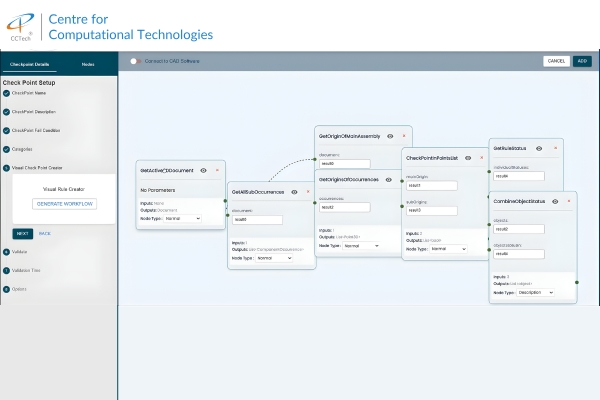
- Step 2Author and govern rules
Experts define, version, approve and manage executable rules without programming.
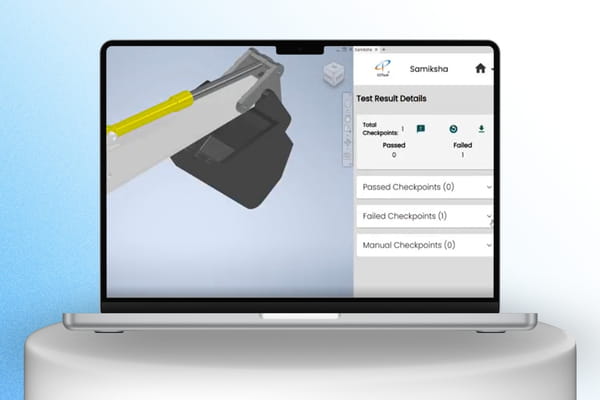
- Step 3Run validations in CAD
Automated checks run inside the CAD tool and at controlled design release gates.
- Step 4Explain and record
Human-readable results, compliance reports and full traceability for audits and certifications.
Faster validation, smarter decisions
Shorter review cycles
Design validation is faster, and review cycles are cut down.
Less manual effort
Engineers no longer read standards and check designs by hand.
Better accuracy
Designs are validated more accurately across manufacturing workflows.
Explainable, defensible compliance
Every check is repeatable and explained, with a complete trail for audits.