





Wednesday, May 13, 2026
The Hidden Cost of Solar and Green Energy Spreadsheets
By
Shashwat Dhase
The Hidden Cost of Solar & Green Energy Spreadsheets
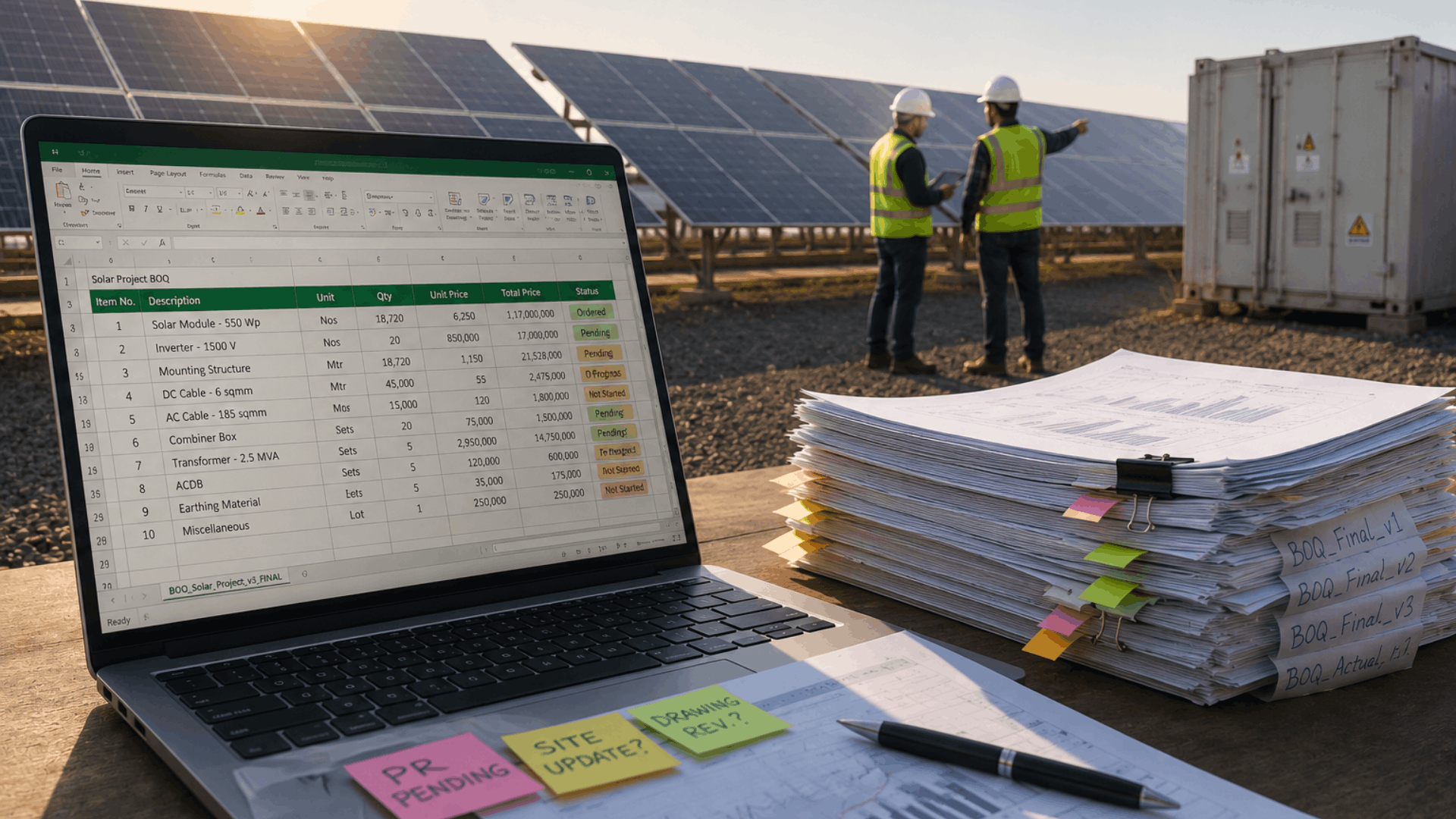
There's a particular kind of chaos that solar EPC companies know all too well. It usually starts around the later stages of a project. It happens when three different versions of the BOQ are floating around in email threads, the procurement team is working off a spreadsheet that was "last updated Tuesday," and someone on site just discovered that the mounting structures delivered don't match what was designed. Cue the phone calls, the blame game, and the scramble.
This incident isn't a one-off. For a surprisingly large chunk of the solar industry, this is the workflow. And it is costing companies far more than they realize.
This incident isn't a one-off. For a surprisingly large chunk of the solar industry, this is the workflow. And it is costing companies far more than they realize.
The Spreadsheet Trap
To be honest, spreadsheets aren't inherently bad. For small tasks, quick calculations, or standalone tracking, they're perfectly fine. The problem starts when solar project teams stretch them into something they were never meant to be, like a project management system, a procurement tracker, a communication layer, and a reporting tool.
When a 50 MW solar project has its bill of quantities (BOQ) living in one Excel file, procurement status in another, and site progress updates into another. This is purely patchwork, which can fail at the worst possible moments.
What's Actually Going Wrong
Version Chaos is the Default, Not the Exception
Ask any project manager how many versions of a BOQ they've dealt with for a single project and watch them pause before answering. When design files stay locked in AutoCAD and material lists are manually extracted and passed around, every handoff creates a new version. Teams end up working off outdated data without even knowing it.
Engineering updates don't automatically flow to procurement. Procurement changes don't reflect the site, and it seems that everyone's technically working on the "latest" version, but they're not.
Engineering updates don't automatically flow to procurement. Procurement changes don't reflect the site, and it seems that everyone's technically working on the "latest" version, but they're not.
Procurement Runs on Gut Feel and Follow-Up Calls
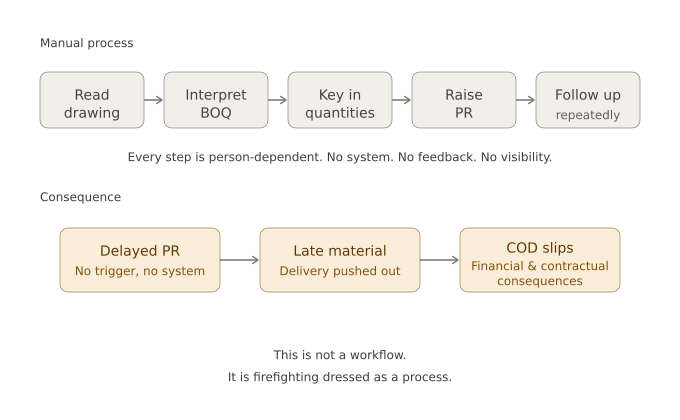
Without a system that connects engineering data directly to purchase requisitions, procurement becomes a manual, people-dependent process. Hence, someone must understand the drawing, interpret the BOQ, enter the quantities, raise a PR, and then follow up multiple times to confirm it was acted on.
This cannot be called a workflow, rather it’s firefighting with extra steps. Delays in raising PRs mean delays in material delivery, and such delays not only slows down the things but also push Commercial Operation Date (COD), leading to financial and contractual consequences.
This cannot be called a workflow, rather it’s firefighting with extra steps. Delays in raising PRs mean delays in material delivery, and such delays not only slows down the things but also push Commercial Operation Date (COD), leading to financial and contractual consequences.
Site Execution Becomes a Guessing Game
Now, there is a situation when materials are issued to a vendor on site. Work is done. However, how much work is done, and what drawings are referred to and verified by whom? When information is available in different places, you lose the ability to reconcile what was issued, what was consumed, and what was actually completed. This situation leads to material leakages, vendor disputes, and the loss of entire audit trail.
Progress Reporting Will Always be Late
The problem gets worse when senior management is demanding the project status, and the project manager takes several hours just to collect information from various sources and compile it into a deck. Consequently, it is never possible to have live data, and decision-making will happen using old data, thereby reducing scope for taking corrective actions in emergencies
Re-work Cost That Nobody Calculates
In solar projects, anything prior to design validation for constructability becomes a costly proposition. There may be mistakes in design, causing cable routing issues and clashes between the structure and the panel placement problems.
Any amount of rework means loss of man hours and additional material costs. But surprisingly enough, these losses are never shown in the spreadsheet as 'Cost of Poor Coordination'.
Any amount of rework means loss of man hours and additional material costs. But surprisingly enough, these losses are never shown in the spreadsheet as 'Cost of Poor Coordination'.
Problem One: An Insufficient Information Exchange
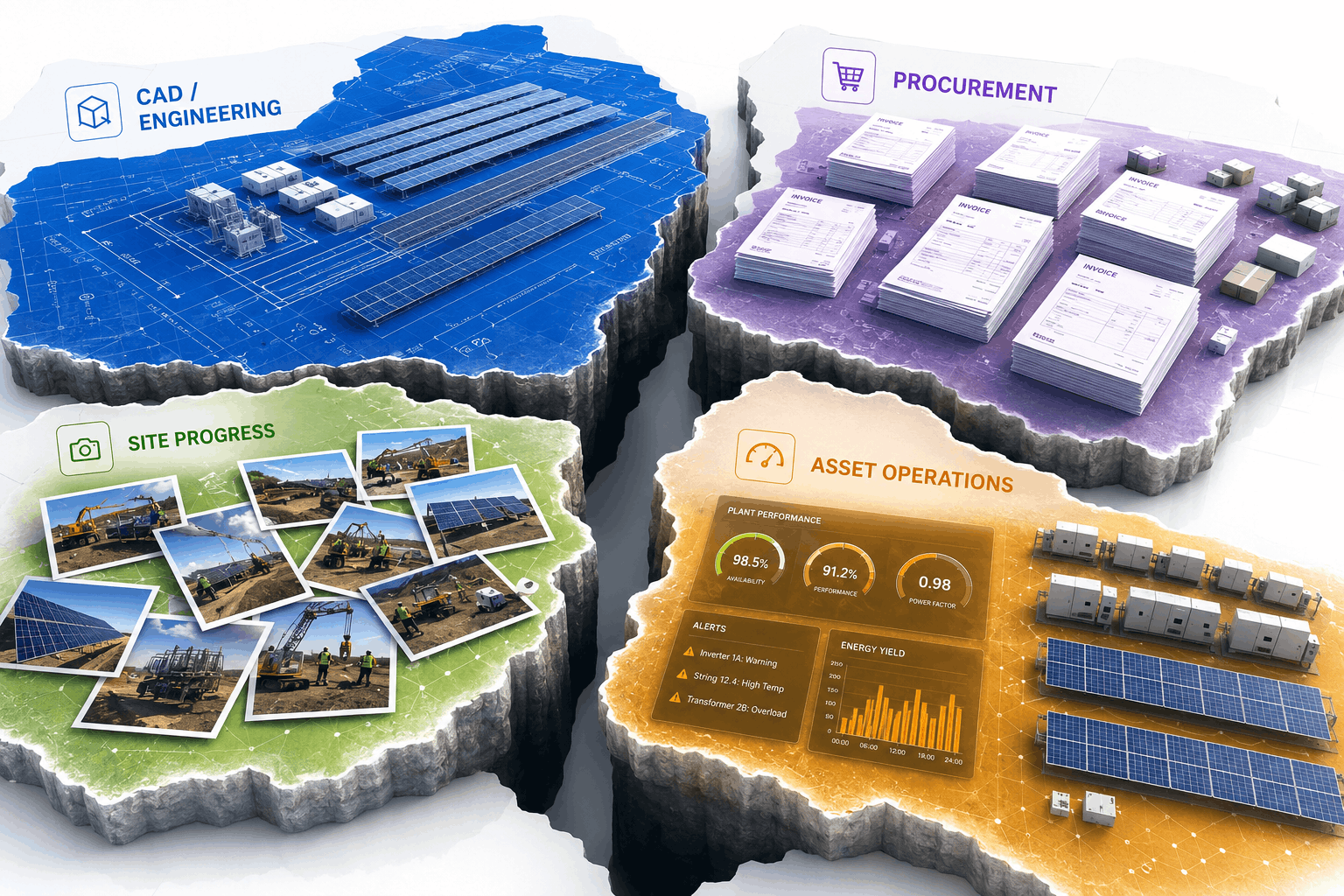
Honestly, the utilization of the spreadsheets creates an informational gap at each level of project execution. Engineering data is stored within the CAD software package. Purchasing data can be found either in emails or in ERP systems. Construction status is stored in the heads of the construction supervisor or even on the camera of a smartphone. Operations data is stored elsewhere. Thus, there is no data exchange or data sharing. It leads to working with insufficient information among decision makers.
Such a gap has some implications. That means a shortage of material, which was discovered three days before planned installation. This also refers to the vendor's invoice disagreement, which will be solved in weeks because there is no evidence of it. This implies a delay in COD payment with penalties. Solar power plant project execution is a complex process that involves many people and requires a lot of time.
Such a gap has some implications. That means a shortage of material, which was discovered three days before planned installation. This also refers to the vendor's invoice disagreement, which will be solved in weeks because there is no evidence of it. This implies a delay in COD payment with penalties. Solar power plant project execution is a complex process that involves many people and requires a lot of time.
What the Industry is Starting to Realize and Recognize
The firms pursuing more aggressive MW goals and faster timelines have begun to recognize something: operational maturity gives them an edge. Those who secure larger deals aren't just skilled engineers; they are efficient operators, coordinated teams, and organized documenters. They have eliminated inefficient manual operations and moved to integrated workflows. They see information not as something that exists in their inbox but as a valuable resource.
The transition is not a question of simply implementing technology. It is a recognition that the cost of doing things in the old-fashioned way, which includes rework, material losses, disputes, and missed COD dates, is too high and threatens to eat away at profitability. In an industry where margins are already shrinking due to declining tariffs and increasing material prices, this is something no one can afford to overlook.
How CCTech is Addressing It?
CCTech’s Green Energy Platform was crafted to plug the knowledge gap plaguing renewable energy ventures. Utilizing Autodesk Forma and custom automation, the Green Energy Platform acts as the ultimate source of truth, bringing all stakeholders, from design engineers to site supervisors to asset owners, under one cohesive ecosystem. The Green Energy Platform transforms AutoCAD engineering drawings into execution data, including:
- Generating BOQ on an activity-by-activity basis and integrating them with material codes SPV/block-wise.
- SAP is automatically synchronized with purchase requisitions upon creation of service orders.
- Site execution can be monitored using a mobile-based solution where progress is tracked via the plan.
Materials issuance is based on a "kitting" model, where vendors will have only those materials that are needed for a particular activity, and reconciliation is done dynamically.
This creates a seamless flow that starts with the design process and extends through BOQ, procurement, construction, reporting, and into assets management, without the break in the process caused by the manual transfer of information. If you're a solar EPC or IPP looking to keep your margins healthy while hitting COD, scalability without growth in staff becomes critical.
Learn more about CCTech's Green Energy Platform →
This creates a seamless flow that starts with the design process and extends through BOQ, procurement, construction, reporting, and into assets management, without the break in the process caused by the manual transfer of information. If you're a solar EPC or IPP looking to keep your margins healthy while hitting COD, scalability without growth in staff becomes critical.
Learn more about CCTech's Green Energy Platform →
It's Time to Retire the Spreadsheet Stack
If your solar projects are still being managed through a collection of Excel files, email threads, and WhatsApp updates, you're not just dealing with inconvenience. Instead, you're absorbing real financial risk on every project.
The hidden costs are stacked up: in rework, in material leakage, in procurement delays, in vendor disputes, in reporting time, and in COD penalties.
The technology to fix this exists. The question is whether your organization is willing to make the shift before the next project teaches you the hard way.
The technology to fix this exists. The question is whether your organization is willing to make the shift before the next project teaches you the hard way.
Interested in seeing how the Green Energy Platform can work for your projects?
Book a conversation with CCTech's experts.
Book a conversation with CCTech's experts.
About author
Shashwat Dhase
Shashwat Dhase is a Manager – Renewable Solutions at CCTech, driving green energy technology engagements and initiatives. He works closely with renewable energy developers, EPCs, and enterprise stakeholders to identify the right opportunities and deliver meaningful business outcomes. With strong expertise in consulting and strategic partnerships, he supports end-to-end customer success. He plays a key role in shaping CCTech’s renewable energy offerings by aligning market needs with effective technical execution. Passionate about innovation, he focuses on solving real industry challenges and accelerating digital transformation across the green energy sector.
To understand how the CCTech Green Energy Platform can support your needs, please connect with our author at shashwat.dhase@cctech.co.in
Comments
Recent posts