





Monday, May 25, 2026
From Design to Decision Intelligence in Engineering Workflows
By
Umaiz Shaikh
From Design to Decision Intelligence in Engineering Workflows
The most interesting question in engineering software today isn't whether AI will help engineers work faster. It's whether engineering tools will continue to assist the work, or whether they'll start to drive the decisions the work depends on.
Most of us in the industry have spent the last two years watching the first wave land. AutoCAD, Civil 3D, Revit, Fusion, InfoDrainage, Autodesk Forma - every meaningful platform now has AI somewhere in its surface. This provides modeling assistance, automation of repetitive tasks, and coordination across connected engineering workflows. The pitch remains consistent.
Most of us in the industry have spent the last two years watching the first wave land. AutoCAD, Civil 3D, Revit, Fusion, InfoDrainage, Autodesk Forma - every meaningful platform now has AI somewhere in its surface. This provides modeling assistance, automation of repetitive tasks, and coordination across connected engineering workflows. The pitch remains consistent.
The shift that actually matters is the second wave, which is starting now: engineering systems that move from assisting work to driving decisions. Not "auto-complete this drawing," but "given these design parameters and these constraints, here are the three configurations worth simulating, and here's why." Not "find the clash," but "the design has a structural risk at junction 14 - here's the rule it violates, here's the historical precedent, here's the corrective action."
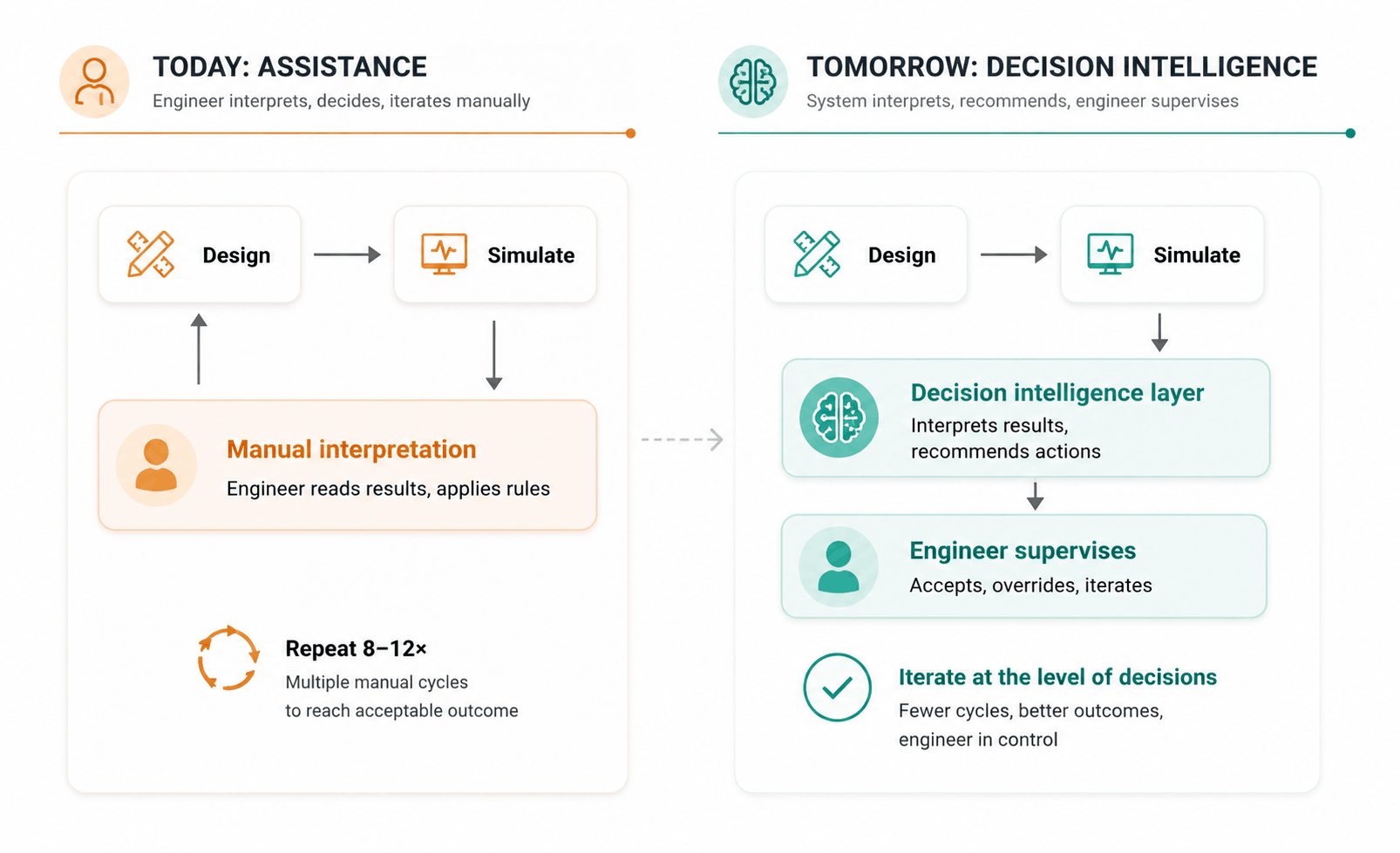
What "assisting" looks like today
A stormwater engineer using Civil 3D and InfoDrainage today works roughly like this. They design a drainage network in Civil 3D, laying out catchments, pipes, junctions, and profiles. They export the network to InfoDrainage. They run a hydraulic simulation. They get back results on flood risks, capacity violations, and points of failure. They go back to Civil 3D. They adjust pipe diameters, change slopes, and redesign sections. They re-export, re-simulate, and repeat until the design passes.
Every step in this loop has AI assistance available in some form. But current capabilities mostly optimise execution efficiency, faster drawing, faster simulation runs. The engineering interpretation layer remains entirely human. Forma can flag coordination issues across disciplines.
What none of these tools do today is interpret the simulation output and decide what to change. That interpretation lives in the engineer's head. So does the rule the design must comply with, the historical precedent for what works, and the contextual judgment about when to bend a rule and when to enforce it. The result is a workflow that's faster than it was ten years ago but still fundamentally manual at the decision layer.
Every step in this loop has AI assistance available in some form. But current capabilities mostly optimise execution efficiency, faster drawing, faster simulation runs. The engineering interpretation layer remains entirely human. Forma can flag coordination issues across disciplines.
What none of these tools do today is interpret the simulation output and decide what to change. That interpretation lives in the engineer's head. So does the rule the design must comply with, the historical precedent for what works, and the contextual judgment about when to bend a rule and when to enforce it. The result is a workflow that's faster than it was ten years ago but still fundamentally manual at the decision layer.
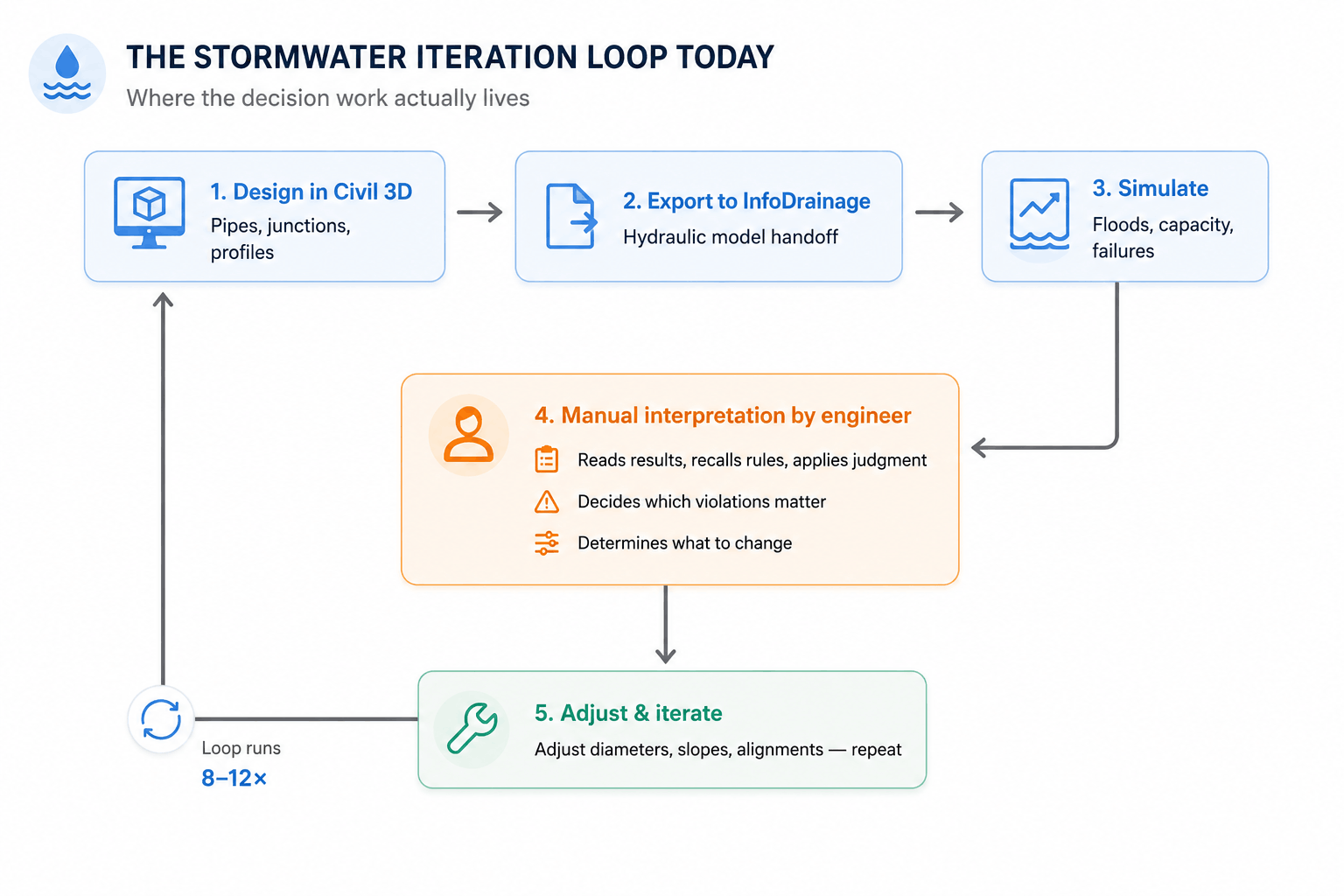
Multiply this across thousands of engineering projects, thousands of design iterations per project, and you start to see the size of the opportunity.
What "deciding" looks like
A decision intelligence layer on top of this engineering workflow would do something different. It would take the simulation output, parse it against the engineering rules that apply to the project, identify which violations matter and which are cosmetic, generate a structured risk assessment, and propose specific design changes, with reasoning the engineer can audit.
For the stormwater example, that means the system reads the InfoDrainage simulation output, recognizes that junction J3 will overflow under 50 mm/hr design rainfall, recognizes that the root cause is insufficient upstream pipe capacity, recognizes that increasing pipe diameter on segments 12–15 from 300mm to 450mm resolves the issue without breaching cost or constructability rules, and tells the engineer:
"Recommend increasing pipe diameter on segments 12–15. This resolves the J3 overflow risk under 50mm/hr design rainfall. Estimated cost impact is +4.2%. Constructability check passes. Confidence: high."
The engineer reviews. They accept or override. They iterate at the level of decisions, not at the level of clicks.
"Recommend increasing pipe diameter on segments 12–15. This resolves the J3 overflow risk under 50mm/hr design rainfall. Estimated cost impact is +4.2%. Constructability check passes. Confidence: high."
The engineer reviews. They accept or override. They iterate at the level of decisions, not at the level of clicks.
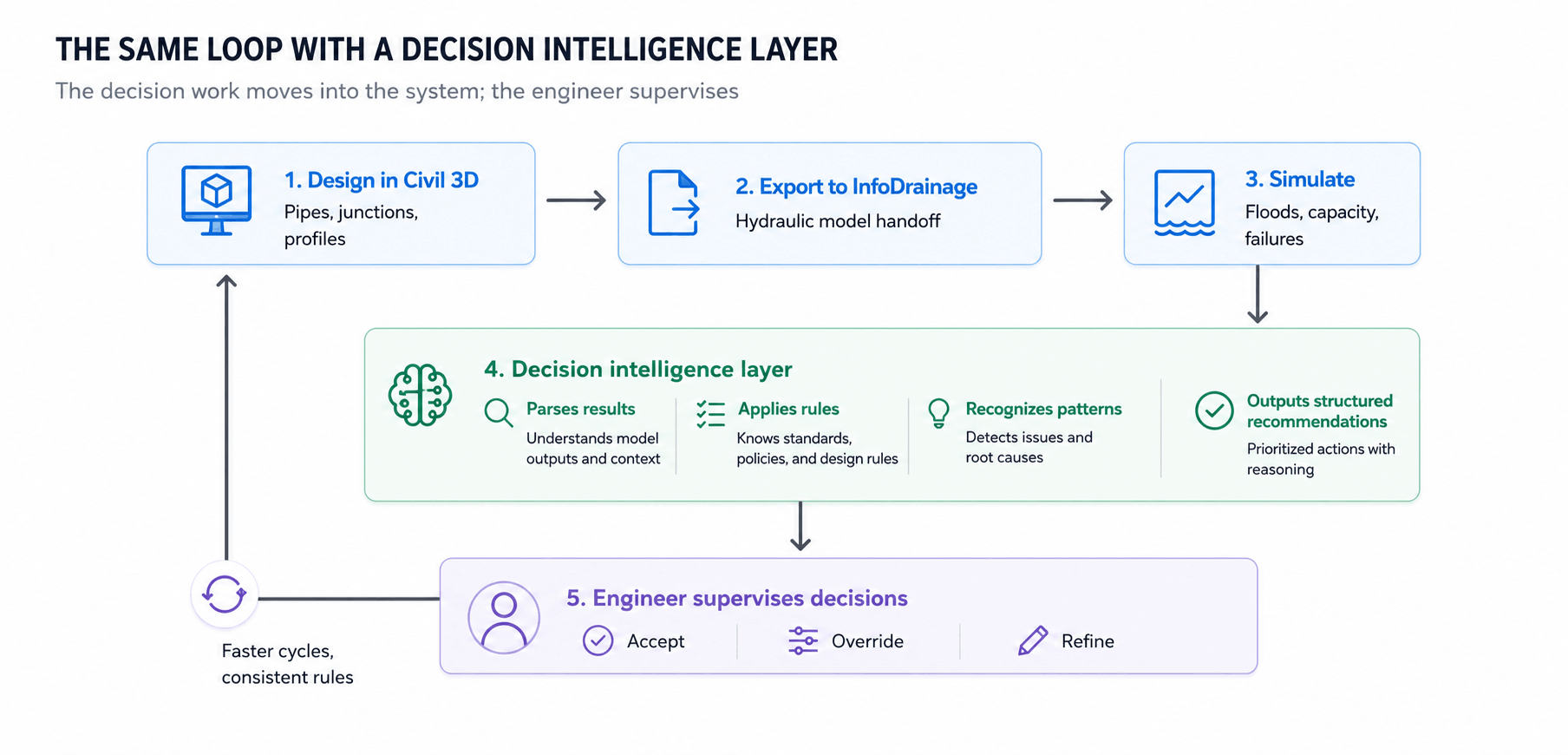
This is not science fiction. The component pieces exist :
What's missing is the integration layer that ties them together and the engineering judgment to do it without producing nonsense.
- Modern simulation tools expose APIs that emit structured output, not just PDFs.
- Engineering rules, design standards, regulatory codes, and organizational best practices can be encoded as machine-readable rule sets, with the right tooling.
- Large language models can read structured simulation output, apply rules, and explain reasoning in natural language.
- Action recommendations can be parameterized against design variables that engineering tools already expose.
What's missing is the integration layer that ties them together and the engineering judgment to do it without producing nonsense.
Where this is harder than it looks
Three problems are genuinely difficult.
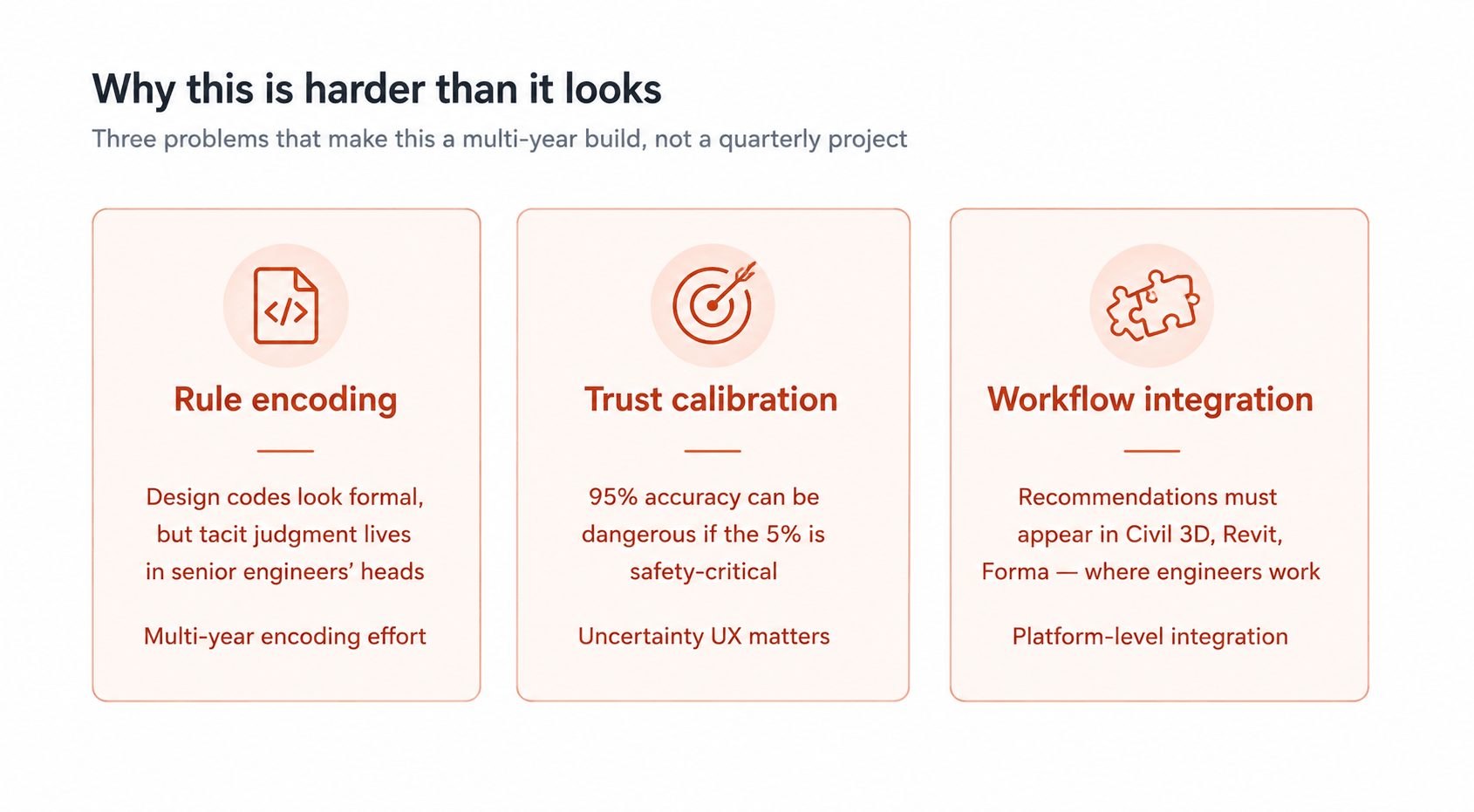
The first is rule encoding. Engineering rules look formal on paper when they're in design codes, in standards documents, and in regulations. In practice, they're full of judgment calls, regional variations, and exception conditions. More difficult still is the tacit knowledge that lives in senior engineers' heads implicit heuristics about when to bend a rule, organisational risk tolerances, site-specific precedents that never made it into any document. Encoding the written standard is hard. Encoding what an experienced engineer knows beyond the standard is a different problem entirely.
The second is trust calibration. A decision intelligence system that's precise 95% of the time is dangerous if the 5% it's wrong includes safety-critical decisions. Engineers will calibrate their trust based on early experiences with the system. If the system is confidently wrong even occasionally, adoption stops. The interface design for uncertainty matters as much as the accuracy of the recommendations.
The third is workflow integration. Engineers don't want a separate tool that runs alongside their existing tools. They want recommendations that appear in Civil 3D, InfoDrainage, and Forma. This requires platform-level integration, not bolt-on AI.
Each of these is solvable technically. But the harder friction may be non-technical liability frameworks, regulatory acceptance, and engineering accountability models will likely evolve more slowly than the software. A system that recommends a pipe diameter change on regulated infrastructure operates in a different risk environment than one that recommends a font size.
Each of these is solvable technically. But the harder friction may be non-technical liability frameworks, regulatory acceptance, and engineering accountability models will likely evolve more slowly than the software. A system that recommends a pipe diameter change on regulated infrastructure operates in a different risk environment than one that recommends a font size.
What it changes when it works
Engineering practice has been organized around a particular bottleneck for the last forty years. The human engineer is the one who interprets results, applies rules, and makes design decisions. The tools have gotten faster. The bottleneck has not moved.
A decision intelligence layer moves the bottleneck. Engineers move from operating tools to supervising decisions. A reasonable objection is that engineering judgment can't be reduced to rule application that experienced engineers reason about things no encoded ruleset captures. That's true. Decision intelligence doesn't eliminate that judgment; it changes where it's applied. From identifying what needs changing, toward validating and governing what the system recommends. Iteration cycles compress from days to hours. Quality improves because rules get applied consistently across every design, not just when the engineer remembers them. New engineers ramp faster because the system encodes institutional knowledge that used to live in heads. And - this is the part the industry hasn't fully reckoned with yet - the firms that build this layer first will have a structural advantage that compounds.
Autodesk is one firm moving in this direction and not alone. Similar patterns are emerging across the broader engineering software landscape as platform vendors converge toward orchestration and agentic workflows. Forma's AI capabilities, the Autodesk Assistant rollout across Fusion / Revit / ACC, and the recent launch of the Design and Make MCP marketplace all point at the same destination. The marketplace is significant. It is an explicit signal that Autodesk wants third-party specialist tools, including engineering simulation, hydraulic analysis, building performance, and computational geometry, to plug into its agentic ecosystem rather than be built inside it. The platform handles orchestration. Specialist partners handle the depth.
This sets up the question I want to take up in the next post: What does it mean to build the specialist intelligence layer on top of an agentic platform like Autodesk's? Where does the value sit? What's the right way for engineering software firms to position themselves?
For now, the point I want to leave you with is this. We are at the start of a shift from engineering tools that assist work to engineering systems that drive decisions. The tools we use in five years will not look like the tools we use today. The firms that recognize this early - and build the decision intelligence layer instead of waiting for someone else to - will define how the next decade of engineering software unfolds.
The transition will happen gradually. The organisations that build the supporting infrastructure early will likely shape how it unfolds.
About author
Umaiz Shaikh
Umaiz Shaikh is Head - AutoCAD Toolsets at CCTech, driving strategic growth and solutioning across the Autodesk ecosystem. He works closely with Autodesk stakeholders and internal teams to identify opportunities, shape scalable solutions, and deliver impactful outcomes. Operating at the intersection of business and technology, he focuses on translating ecosystem insights into actionable strategy. His work contributes to strengthening CCTech’s position as a trusted and strategic Autodesk technology partner.
Comments
Recent posts