





Monday, July 13, 2026
Generative Design in AEC: Automating Design Iterations Faster
By
Shubham Dom
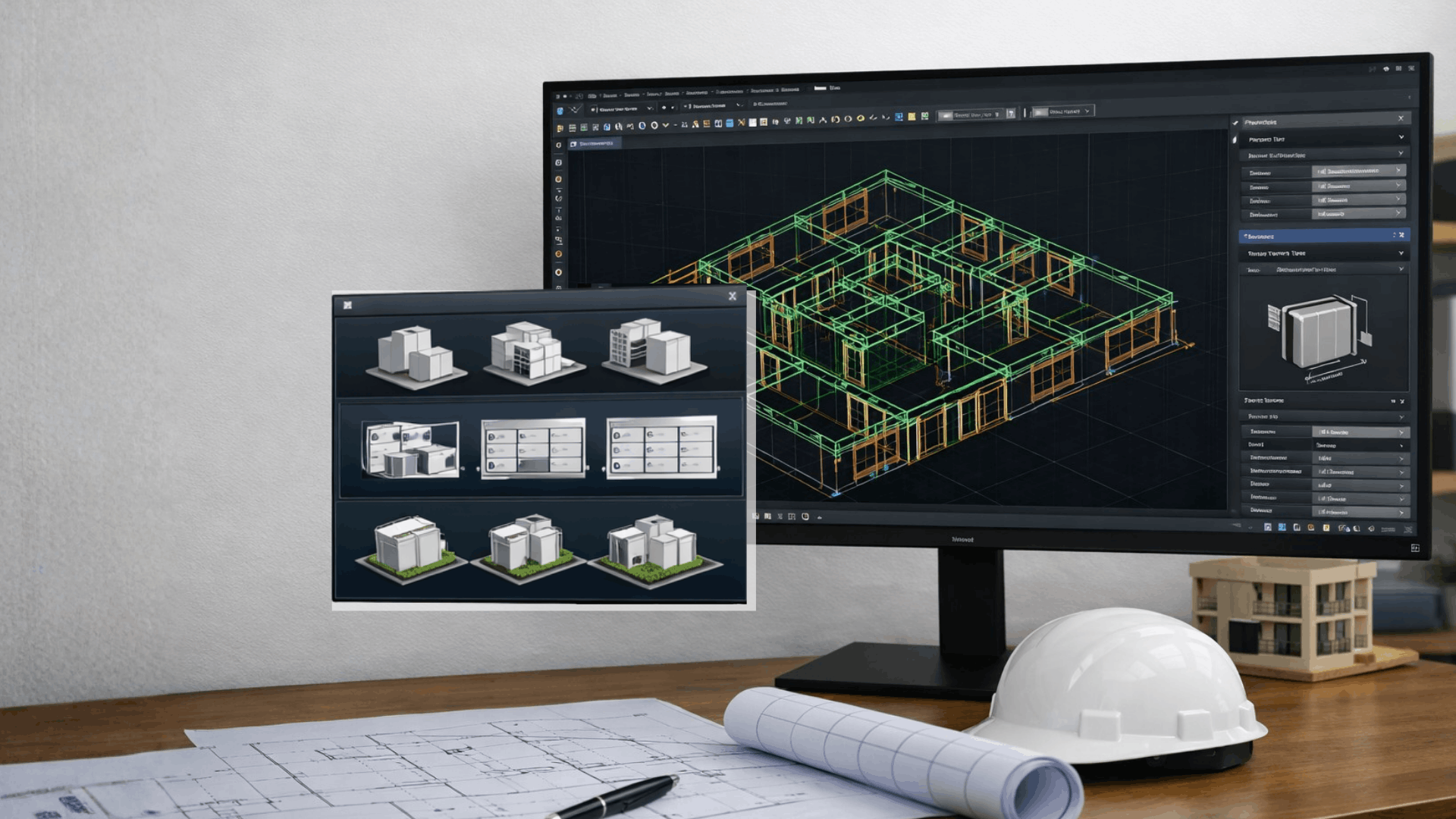
Understand the Dilemma of Speed and Precision in AEC
Every architecture, engineering, and construction (AEC) team struggles to deliver designs faster, without compromising the quality of documentation or compliance with standards. Balancing speed and precision becomes way harder when project timelines shrink and client expectations rise.
Many organizations are still fighting this battle with manual processes. Drawings are hand-annotated, models are updated as individual elements, and standards are checked using review checklists. Consequently, as design moves from CAD and BIM systems, teams can only expect erratic results, lengthy manufacturing timelines, quality issues, and disjointed data.
That is where CCTech is filling the gap. We bring design principles, standards, and practices into the fold of smart, rule-driven tools. This steers AEC businesses away from manual and one-off fixes to maintain harmony between speed and precision.
From Traditional Drafting to Generative Thinking
To understand what's changing, let‘s initially see where generative design sits on the design technology spectrum. Traditional design begins with basic drafting skills, which include sketching an idea and then reproducing it in the CAD software. Design automation extends the relationship between elements through parametric design. This leads to applying rules across a model.
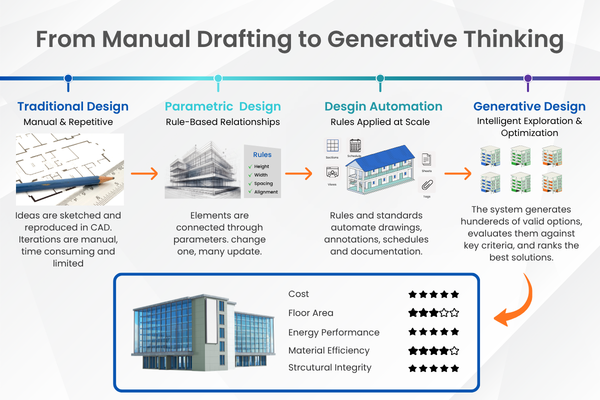
Generative design builds on all of this. The designer sets goals and constraints and generates hundreds of valid layouts. Later, these are ranked according to important criteria: cost, floor area, energy performance, material efficiency, or structural integrity. The designer's job is to explore all possibilities and curate the best possibilities of design.
The process can be thought of in three different ways: Goals (why are we designing this), Evaluators (how will we measure success), and Generators (how will we produce candidate solutions by iterating layouts, adjusting massing, and testing structural variants).
The process can be thought of in three different ways: Goals (why are we designing this), Evaluators (how will we measure success), and Generators (how will we produce candidate solutions by iterating layouts, adjusting massing, and testing structural variants).
When generators are guided by evaluators tied to real goals, design exploration stops being guesswork and becomes a disciplined, data-backed search for the best-performing option.
Autodesk frames its own generative design strategy around a similar set of principles: encode the rules that express a project's design intent and constraints, surface the full range of possible outcomes so decisions are data-backed rather than guesswork, and preserve that logic so it can be reused across future projects instead of starting from scratch each time (Source: https://www.autodesk.com/autodesk-university/article/Design-Automation-Generative-Design-AEC-2020 )
Why Design Iterations Get Faster
In AEC, Generative Design is a process to shorten the timeline from “we have an idea” to “we have a validated, buildable option.” Architectural massing studies can take into account floor count, façade area, and compliance with floor-area ratio in a single study. Structural teams can analyze placement solutions and conduct simulations to test how a proposed structure will interact with its surrounding site context within zoning parameters.
This is where rule-based automation comes in handy. The same types of drawings, annotations, and model elements are constantly reworked on the same types of engineering projects in AutoCAD, Revit, Tekla, and Plant 3D. Each repetition of the manual step is a place where iteration slows down, and inconsistency slips in.
To directly address this issue at CCTech, we have automated the creation of drawings, views, sections, schedules, tags, and sheets, and standardized the layers, families/blocks, title blocks, parameters, and naming conventions across BIM platforms. If a model is constructed in advance of these rules, teams will not waste cycles on cleanup and will begin to spend cycles on making decisions.
Explore our design automation process here: https://www.cctech.co.in/services/design-automation-for-cad-and-bim-applications
Configurators take this step further to truly generative space. The main drivers of rework and delay are late-stage rework and re-entry of customer-specific customizations, especially in Revit, Inventor, SolidWorks, and Tekla. To solve this, we involve sending input-based configurators to parameterized models and drawings. Requirement changes become a new, compliant configuration in minutes, not days. Design variants are automatically generated by the built-in guardrails based on engineering rules, constraints, and compliance limits. Reusable component libraries provide another element of speed and allow project modeling to be done quickly and easily.
What This Means for AEC Businesses
The payoff of this shift shows up in three places that matter directly to the bottom line:
Higher quality
designs Provides more alternative design solutions
Greater speed
Evaluation and drafting occur computationally
Lower costs
Problems are optimized before construction begins
For AEC firms, this translates into the ability to take on more projects without proportionally growing headcount, respond to client change requests without derailing a schedule, and win work on the strength of design options that would have been too time-consuming to produce manually.
The Shift Is Already Underway
Generative design is no longer an experimental concept confined to research labs. It is actively reshaping how AEC teams approach everything from conceptual massing to construction sequencing. As AI and machine learning continue to mature, the range of problems generative workflows can tackle will only expand, and the organizations that have already automated their standards and design logic will be the ones best positioned to take advantage of it.
About author
Shubham Dom
Shubham Dom is the Manager of the AECO business, driving Autodesk AECO and Autodesk Construction Cloud (ACC) solutions across India, Asia, and the Middle East. He focuses on building end-to-end digital construction management ecosystems, with ACC as the core platform integrated with custom applications and enterprise systems. He specializes in custom software development, Autodesk customization, and scalable platform design, delivering BIM-led and data-driven solutions.
Comments
Recent posts