



Friday, May 29, 2026
How PLM and ERP Integration Can Transform Your Manufacturing Workflows
By
Dhirendra Patil
Transform Manufacturing Workflows with PLM-ERP Integration
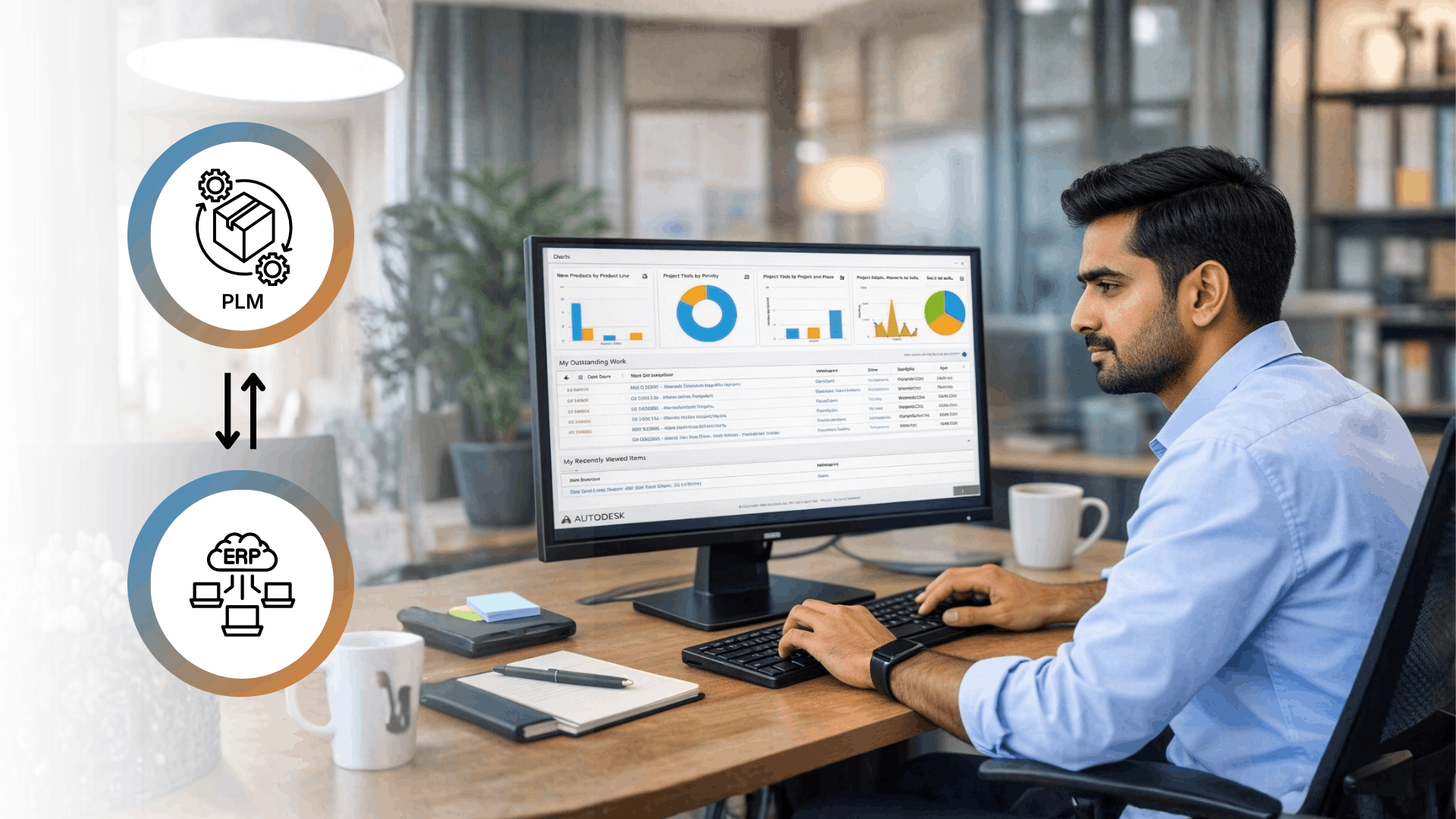
Modern enterprises require an array of technologies working in sync to achieve their production, quality, and financial goals for their projects. It is not necessary that a project failure is caused by technology. In the era of voluminous information, data handover has been a concern in many failed projects. In the manufacturing sector, a single mismatch between engineering workflow and production bill of materials (BOMs) can stall a production line, delay a customer shipment, and trigger a chain of manual corrections across departments. Most of the manufacturing organizations haven't bridged their two most critical enterprise systems: Product Lifecycle Management (PLM) and Enterprise Resource Planning (ERP).
When these systems work in sync, product information flows seamlessly from design to the final stage of the process. When they don't, the handover gap reveals delays, duplicate data, and decisions are made on outdated information.
At CCTech, we've seen both sides of that equation. Let’s dive in and explore what manufacturers need to understand.
Where Most Manufacturers Get Stuck
Manufacturing organizations rarely struggle with tools. They struggle with handovers. It is the point where information must move from one team, one system, or one phase to the next.
Engineering teams design in PLM environments. Production, procurement, and finance teams operate in ERP. And somewhere between those two worlds, data gets duplicated, revised BOMs get lost in email threads, and change orders take days longer than they should.
The deeper challenge is structural. Many PLM implementations are built without a clear plan for how product data will be consumed. On the other hand, ERP systems are configured for financial and operational logic. Teams decide on integration, but both systems are underdelivering. And teams quietly build various workarounds. These workarounds are a warning sign. If not attended to, the handover gap has already become a business problem.
Why PLM–ERP Integration Is a Business-Critical Decision
For a smooth handover between the product development and product execution teams, PLM-ERP integration is a necessity. This ultimately determines how the organization’s management makes quick decisions and aligns the process faster.
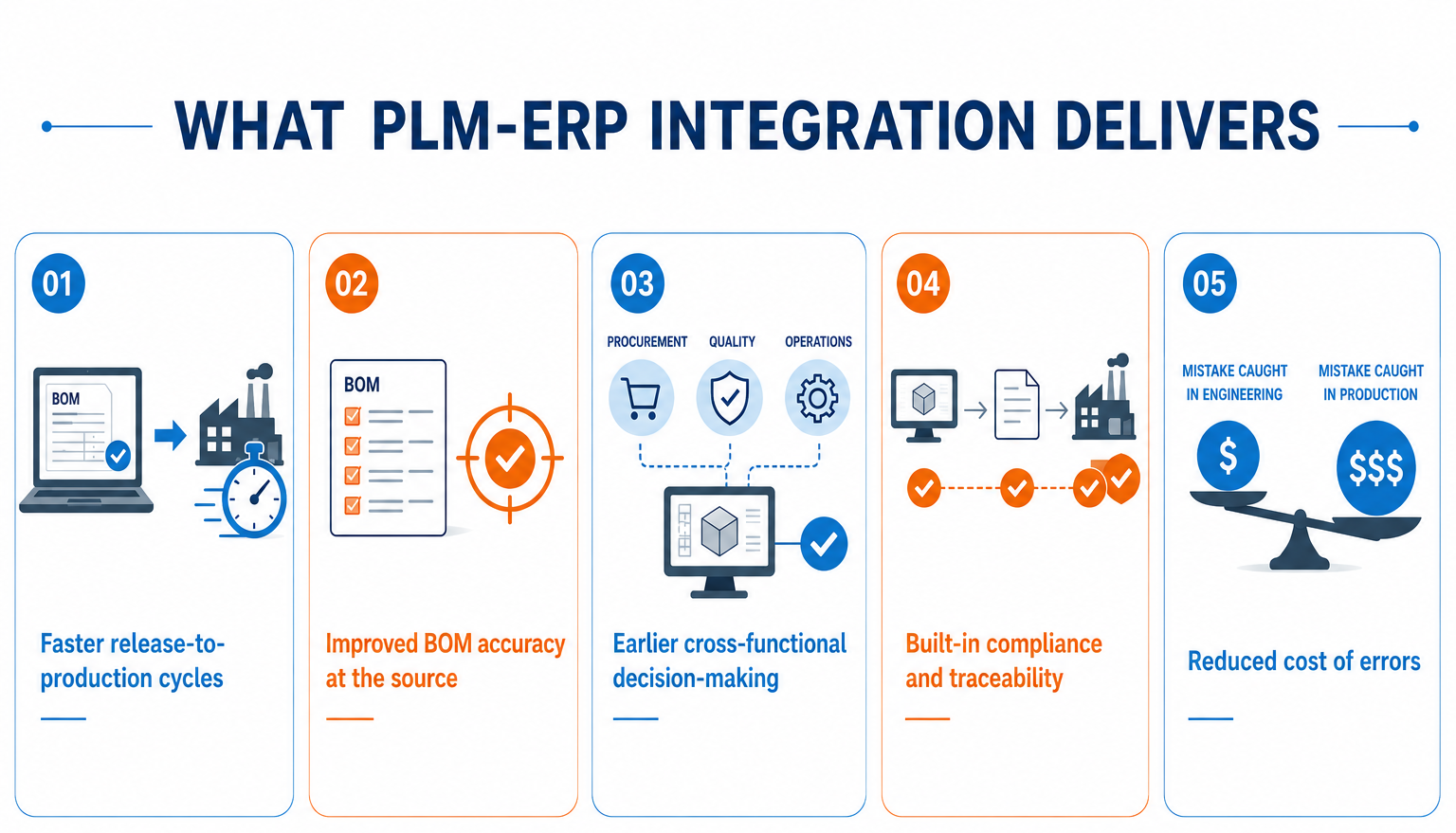
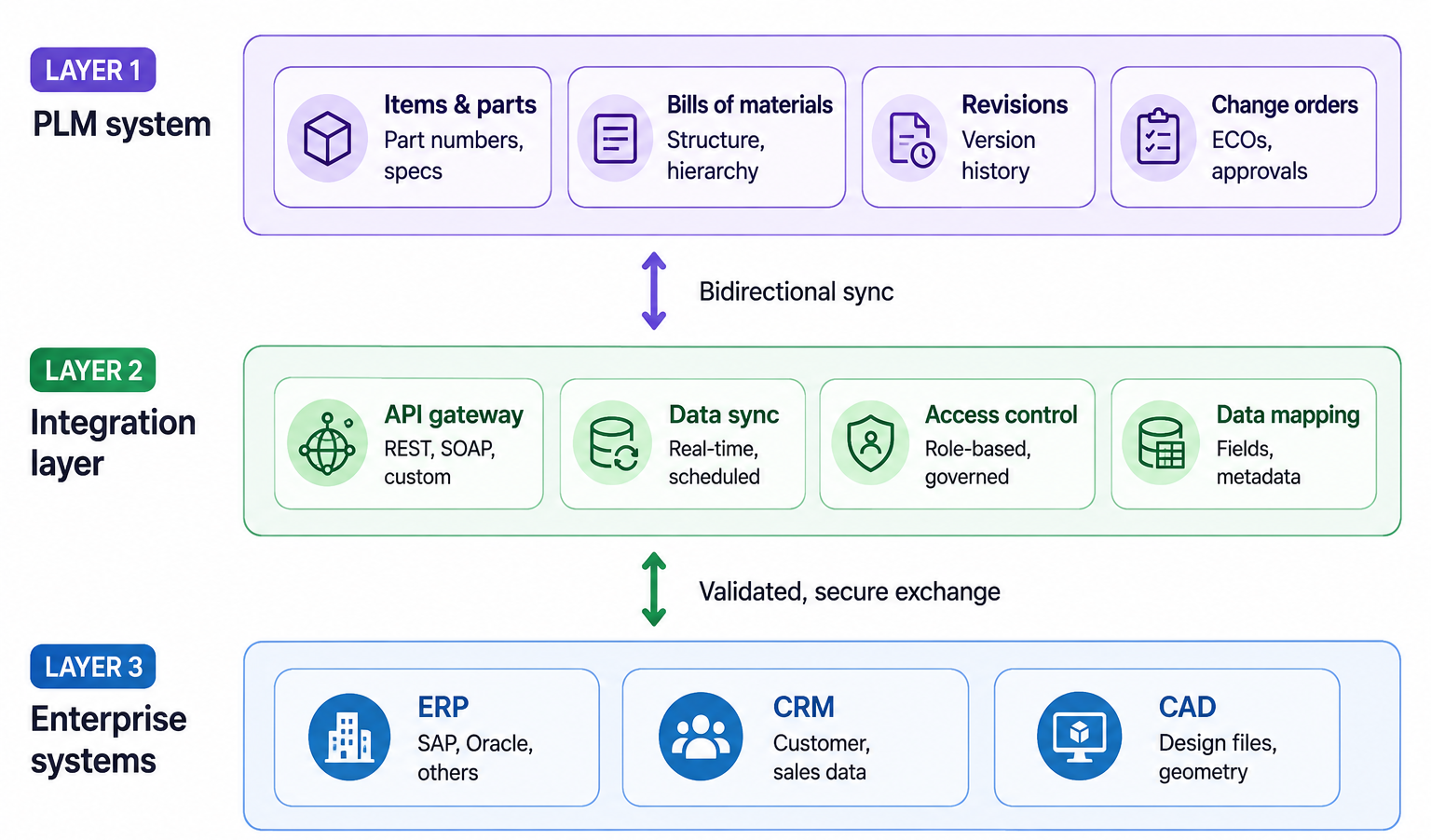
In a real scenario without integration, the engineers release a BOM into PLM, and someone from the production team manually re-enters it into ERP. This increases the likelihood of errors, consumes more time, and breaks traceability. With integration, that same BOM is transferred automatically, with revision history, metadata, and change context.
Organizations that close the handover gap between PLM and ERP make faster, better-informed decisions than competitors who don't.
Organizations that close the handover gap between PLM and ERP make faster, better-informed decisions than competitors who don't.
CCTech Capabilities That Make Integration Work
PLM–ERP integration creates a governed data pipeline across the enterprise. At CCTech, we deliver this through five interconnected practice areas-
Implementation Aligned to Your Business
Every organization approves and releases products differently. Before implementing the configuration, we map the real-world processes. Using PLM platforms like Autodesk Fusion Manage, manufacturing workflows are set up to mirror existing practices. It includes lifecycle definitions for parts, documents, BOMs, change orders, user roles, approval structures, and data visibility controls.
Every organization approves and releases products differently. Before implementing the configuration, we map the real-world processes. Using PLM platforms like Autodesk Fusion Manage, manufacturing workflows are set up to mirror existing practices. It includes lifecycle definitions for parts, documents, BOMs, change orders, user roles, approval structures, and data visibility controls.
PLM–ERP Integration in Production Environments
When ERP systems like SAP and Oracle reliably consume our data from PLM, only then is integration valued. Our integration work maps items, BOMs, revisions, and metadata between systems to align change processes. This also enhances data security with ERP change management. Integrations are thoroughly validated in testing environments before any production deployment.
When ERP systems like SAP and Oracle reliably consume our data from PLM, only then is integration valued. Our integration work maps items, BOMs, revisions, and metadata between systems to align change processes. This also enhances data security with ERP change management. Integrations are thoroughly validated in testing environments before any production deployment.
Targeted Customization
Every business has different and critical overflows. We extend the PLM platform’s capabilities through targeted customizations. It includes automated alerts, role-specific dashboards, filtered views, controlled document access, and extensions built specifically to support ERP and third-party system integrations. These additions close functional gaps without compromising compliance.
Every business has different and critical overflows. We extend the PLM platform’s capabilities through targeted customizations. It includes automated alerts, role-specific dashboards, filtered views, controlled document access, and extensions built specifically to support ERP and third-party system integrations. These additions close functional gaps without compromising compliance.
Structured Data Migration
We follow a phased migration approach because data must be migrated with trust. It starts with reviewing existing data sources, defining the system of record, cleaning, and validating data before it transitions among phases. Version history, relationships, and critical metadata are stored throughout, so teams have a clean, reliable, collaborative environment.
We follow a phased migration approach because data must be migrated with trust. It starts with reviewing existing data sources, defining the system of record, cleaning, and validating data before it transitions among phases. Version history, relationships, and critical metadata are stored throughout, so teams have a clean, reliable, collaborative environment.
Advisory and Digital Thread Planning
Unifying and connecting siloed data, processes, and systems throughout the product lifecycle needs a framework, a digital thread strategy. To position PLM as part of a broader digital thread strategy, we conduct assessments, map and optimize processes, define data flow, support user adoption, change management, and plan for governance, scalability, and long-term evolution.
Unifying and connecting siloed data, processes, and systems throughout the product lifecycle needs a framework, a digital thread strategy. To position PLM as part of a broader digital thread strategy, we conduct assessments, map and optimize processes, define data flow, support user adoption, change management, and plan for governance, scalability, and long-term evolution.
From Real Challenges to Real Results: A CCTech Perspective
CCTech has helped a leading manufacturing organization achieve full PLM adoption with Autodesk Fusion Manage in just 90 days. Our goal was a smooth transition to a better with zero disruptions.
The engagement started with a detailed review process: how engineering data moved, who approved what, and where the current system created friction. Rather than imposing a generic implementation template, the team configured Fusion Manage workflows to mirror the client's existing practices and identified where targeted customization was needed.
Migration was handled as a phased process, with data syncing continuously between old and new environments right up to final cutover. The business never had to halt operations to make the transition work.ERP and CRM integration was built collaboratively, with direct involvement from the client's system partners, validated in sandbox environments, and aligned to real production triggers.
Read more about our customer success story:
https://www.cctech.co.in/customer-success-story/manufacturing-leader-seamless-transition-to-autodesk-fusion-manage-plm
Getting Integration Right from the Start
At CCTech, we approach every PLM–ERP integration by first understanding how your organization already operates and then building a handover layer that fits, rather than forces change. The goal is a system your teams use, with data they can trust, flowing reliably to every function that depends on it.
If your organization is evaluating PLM-ERP integration or looking to close the handover gap in an existing integration, we'd welcome a conversation.
Explore more about our integration services here: Autodesk Fusion Manage PLM | ERP Integration
About author
Dhirendra Patil
Dhirendra Patil is a Manager – Digital Factory & Manufacturing AI at CCTech, a leading digital transformation company driving Digital Factory and AI initiatives for manufacturing enterprises. He builds end-to-end digital manufacturing ecosystems using Autodesk Platform Services, integrating PLM, ERP, and MES into a unified digital thread. With expertise in custom software development and system integration, he delivers data-driven platforms, engineering design validation solutions, and complexity-reduction tools that improve efficiency, standardization, and decision-making. He also applies design automation, digital twin concepts, and discrete event simulation to drive productivity, visibility, and measurable outcomes across engineering and operations.
Comments
Recent posts