





Wednesday, May 13, 2026
How Constraints Are Reshaping Manufacturing Scheduling
By
Riyaelza Pappachen
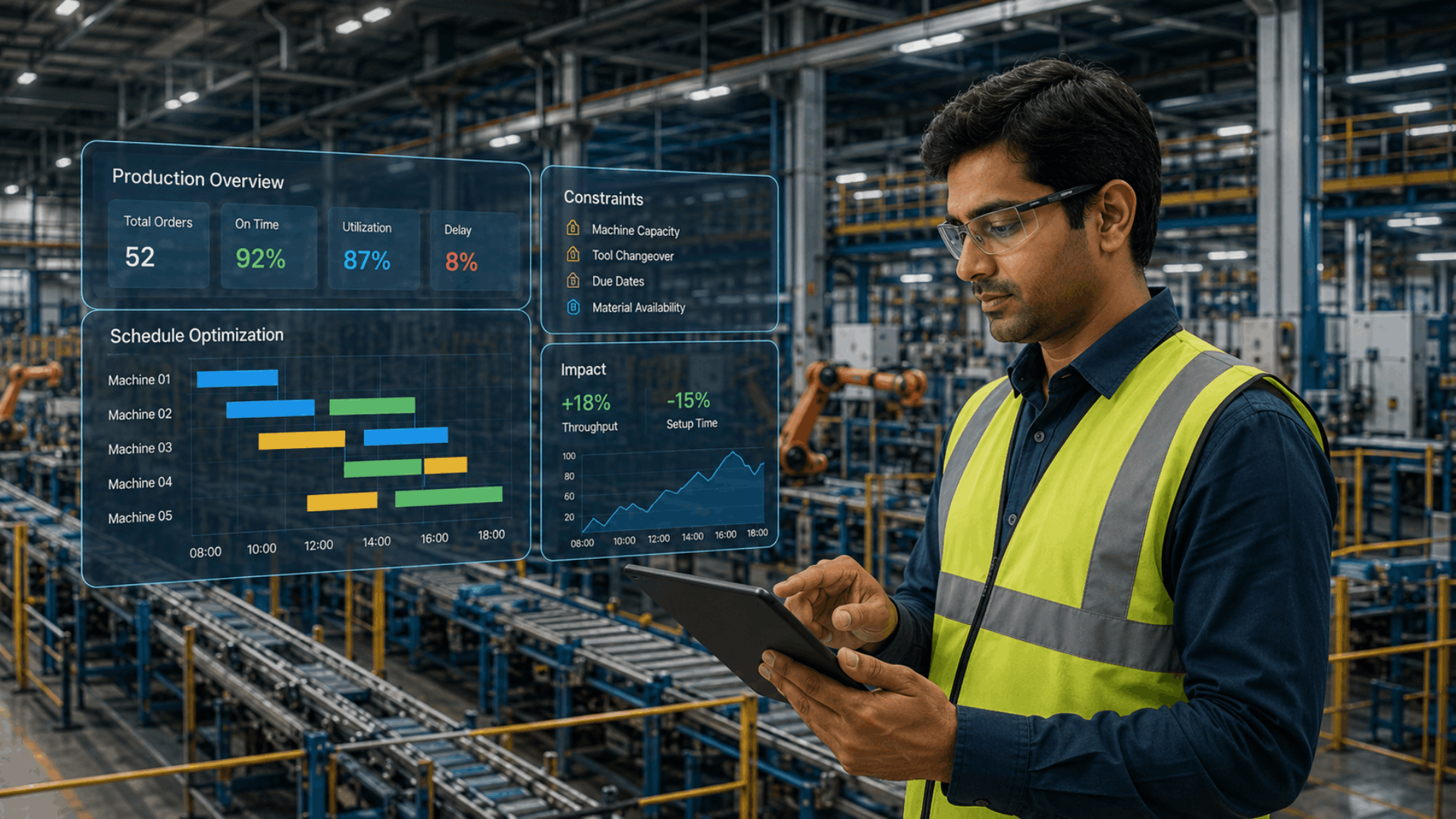
How Constraint-Based Optimization Is Changing the Production Scheduling ?
The major challenge often overlooked by operators is Product Scheduling in manufacturing. If ignored, this results in compounding costs. Every time a production line switches from one job to another, there's a setup period including tooling changes, calibrations, and cleaning runs. These moments are invisible on the profit-and-loss scale.
At CCTech, innovation doesn't wait for a boardroom brief. Sometimes it starts with a whiteboard, a hackathon clock, and a nagging question:
What if we could squeeze machine time and improve overall production?
Team Ctrl+Alt+Defeat answered the above question during CCTech’s internal hackathon. Shreyash Kothare, Satvik Sinha and Hardik Balwani approached the problem with rigor.
The Invisible Cost of Poor Sequencing
Every time a machine switches from one job to another, it incurs a setup or changeover. It is reflected in terms of cost, time spent reconfiguring tooling, recalibrating parameters, or cleaning the line. Individually, these transitions seem negligible. Collectively, they consume 10% to 30% of total machine time in a typical production environment. Manufacturing benchmarks show that 20–40% of production time is consumed by non-value-adding tasks, while poor sequencing decisions alone account for 5–10% of avoidable capacity loss. That is the capacity to be silently eroded.
The root cause is inefficient production scheduling in the manufacturing industry. Spreadsheets cannot reliably handle assignments of dozens of jobs across multiple machines. It happens while accounting for setup dependencies, delivery deadlines, machine compatibility, and resource constraints. What is needed is intelligent, constraint-aware process optimization at scale.
CCTech’s Approach to Scheduling Intelligence
CCTech's approach to this problem is in the field of constraint programming. It is an application of operations research that has been used for decades in industrial scheduling systems across the aeronautical, automotive, and semiconductor industries. The key engine is based on Google OR-Tools' CP-SAT Solver, which is a state-of-the-art combinatorial optimizer that searches for complex, multi-variable decision spaces.
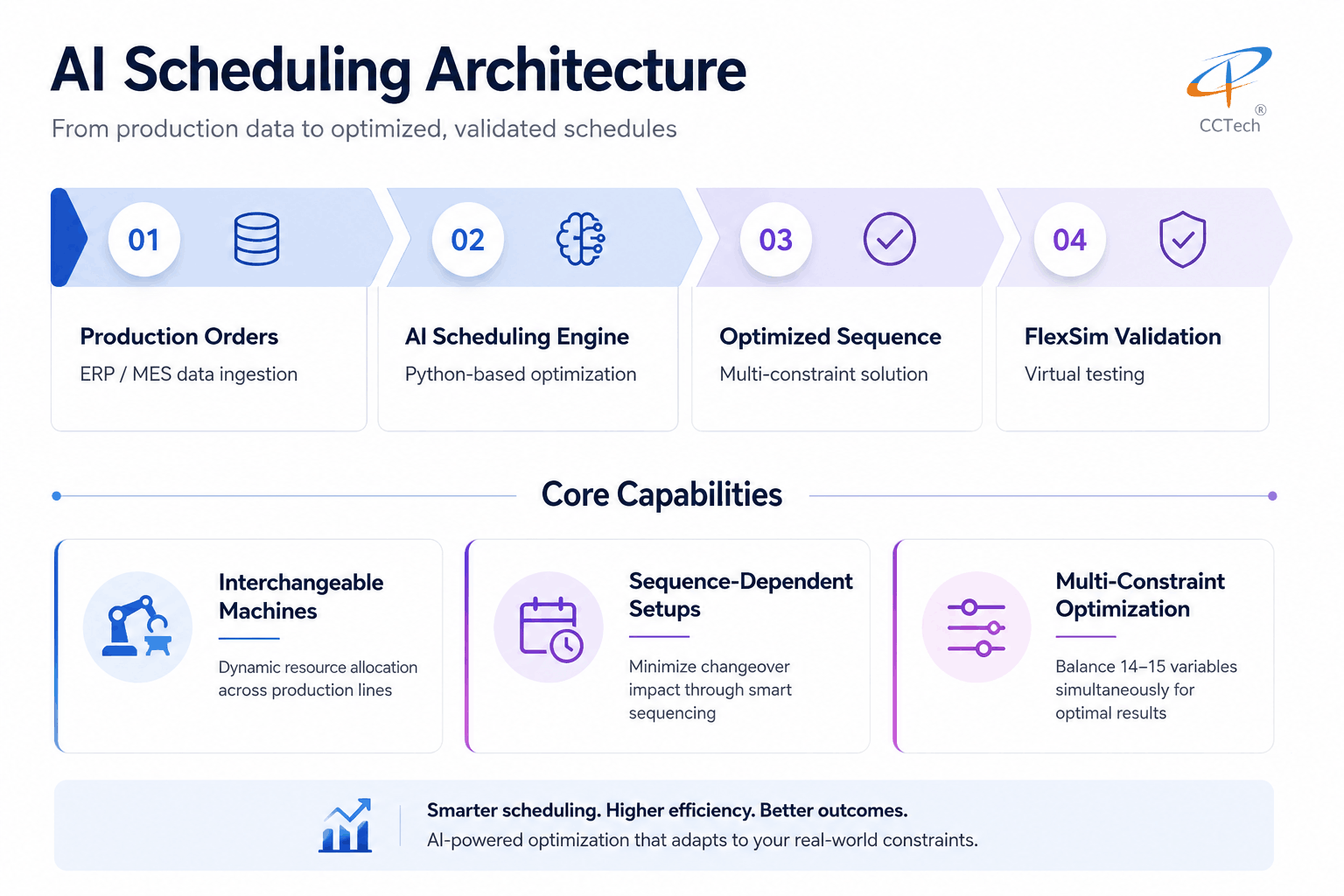
The system follows a four-stage pipeline: production orders are ingested directly from ERP or MES systems, passed through the AI scheduling engine for Python-based optimization, an optimized multi-constraint sequence is generated, and the output is validated using FlexSim simulation for virtual testing before deployment.
The system also accounts for the modeling of 14-15 concurrent production variables. The optimizer then maps the jobs to machines and schedules it for quick sequencing. This results in two basic objectives:
- Setup cost — by grouping jobs with similar tooling signatures to reduce changeover frequency and duration
- Time optimization — the total elapsed time from the first job start to the last job completion across all machines
Rather than treating each job transition as a simple binary switch, the system encodes multi-variable changeover dependencies into a structured signature. This allows the optimizer to accurately price the cost of any job-to-job transition and intelligently cluster for similar jobs.
From Raw Data to Ready-to-Use Schedules
One of the practical realities of manufacturing environments is that production data is rarely clean. Columns are inconsistently named, rows are fragmented across work orders, and values are sometimes missing entirely. CCTech system addresses this upstream with a robust preprocessing layer for efficient production scheduling.
On the output side, the system generates structured Excel schedules via OpenPyXL. Crucially, it also produces a side-by-side AS-IS versus optimized comparison to analyze the improvements achieved. The system tracks four core KPIs throughout: setup time, machine utilization, production throughput, and schedule stability.
Measured Results and the Road Ahead
Applied to real-world production datasets, the system targeted a 10–25% reduction in changeover time and an 8–15% improvement in machine utilization. As a result, it delivered approximately a 56% reduction in aggregate setup cost, significantly exceeding baseline targets. The impact is tangible. To understand the significance of result, consider the below example-
Example: A facility running 20 machines across two shifts, with conservative scheduling, translates to over 1,200 hours of recovered production time annually. This indicates more output, without a single rupee of new capital investment in equipment. It directly translates into reclaimed machine capacity, higher throughput, and improved schedule adherence.
Future extensions will cover dynamic production scheduling in the event of disruption on the shop floor in real time, estimation of setup time for the production in real time based on predictive models developed by the Random Forest algorithm, integration with ERP and MES for data exchange and multi-plant optimization for distributed production networks.
Future extensions will cover dynamic production scheduling in the event of disruption on the shop floor in real time, estimation of setup time for the production in real time based on predictive models developed by the Random Forest algorithm, integration with ERP and MES for data exchange and multi-plant optimization for distributed production networks.
Why This Matters
At CCTech, we approach manufacturing challenges not by adding complexity, but by applying rigorous engineering thinking to problems already there. Production scheduling is one of the most computationally rich and operationally consequential problems in modern manufacturing, and it has been underserved by technology for too long.
In a world where a 10% scheduling improvement can materially shift a plant's economics, we believe intelligent process optimization is an immediate imperative.
About author
Riyaelza Pappachen
Riyaelza Pappachen is a dedicated Software Development Engineer in Test (SDET) at CCTech, where she works in the AEC (Architecture, Engineering, and Construction) domain with a strong focus on Autodesk ReCap. She plays a key role in ensuring the quality, performance, and reliability of the ReCap product through comprehensive manual and automated testing. She has expertise in identifying and resolving defects in ReCap workflows and development cycles
Comments
Recent posts