





Tuesday, January 13, 2026
Digital Factory vs Smart Factory: Business Impact Explained
By
Hemant Jadhav
With businesses on the fast track to digital transformation, you likely hear the terms "Digital Factory" and "Smart Factory" tossed around frequently, often in an interchangeable manner. However, from a business and financial standpoint, these two ideas deliver value at completely opposite ends of the enterprise value chain.
Differentiating between a digital factory and a smart factory matters to business leaders who are looking to drive capital efficiency, operational margins, risk management and long-term ROI improvements.
This blog talks about what they are and how each complements the other, delivering business benefits throughout an organization.
What Is a Digital Factory?
The Digital Factory is primarily a strategic decision-support framework. It allows enterprises to digitally design, simulate and validate systems, processes, and workflows for execution in a stable manner.
From a business standpoint, the digital factory exists to reduce uncertainty before committing capital.
Why You Should Choose Digital Factory?
- Reduced risk of investment through scenario simulations
- Reduced rework and change costs
- Improved capital allocation decisions
- Faster time-to-market
- Higher predictability of outcomes
Executives can evaluate multiple “what-if” options — what it would take in terms of time, cost and resources, before they spend money or make any decisions.
Financial Impact
The digital factory primarily delivers cost avoidance:
The digital factory primarily delivers cost avoidance:
- Prevents expensive redesigns
- Minimizes project overruns
- Reduces delays caused by poor upfront planning
What Is a Smart Factory?
Commercial Benefits:
- Lower operating costs
- Higher productivity and asset utilization
- Reduced downtime and service disruptions
- Improved quality and customer satisfaction
- Scalable, data-driven operations
- Smart factories transform operational data into quantifiable financial results.
Financial Impact:
The intelligent factory monetizes with direct and recurring financial value:
The intelligent factory monetizes with direct and recurring financial value:
- Operating cost reduction
- Margin improvement
- Revenue protection through reliability
- Improved service-level performance
Comparing Business Impact
| Business Dimension | Digital Factory | Smart Factory |
|---|---|---|
| Primary Focus | Planning & validation | Execution & optimization |
| Value Timing | Before implementation | During operations |
| Financial Benefit | Cost avoidance | Cost reduction & revenue uplift |
| Risk Management | Proactive | Predictive & reactive |
| Decision Level | Strategic & leadership | Operational & tactical |
| ROI Horizon | Medium to long term | Short to medium term |
In simple terms, the digital factory protects capital, while the smart factory improves margins.
Why the Distinction Matters for Business Leaders
There are several companies that spend a lot on smart initiatives without any real-time validation. This often leads to:
On the other hand, organizations that adopt a Digital Factory first:
- Underutilized systems
- Higher-than-expected operating costs
- Slower ROI realization
On the other hand, organizations that adopt a Digital Factory first:
- Enter execution with greater confidence
- Deploy smart capabilities more effectively
- Achieve faster payback periods
The top performing firms view Digital Factory vs Smart Factory as not either/or, but both/and investments that build on each other.
Combined Business Value: A Closed-Loop Advantage
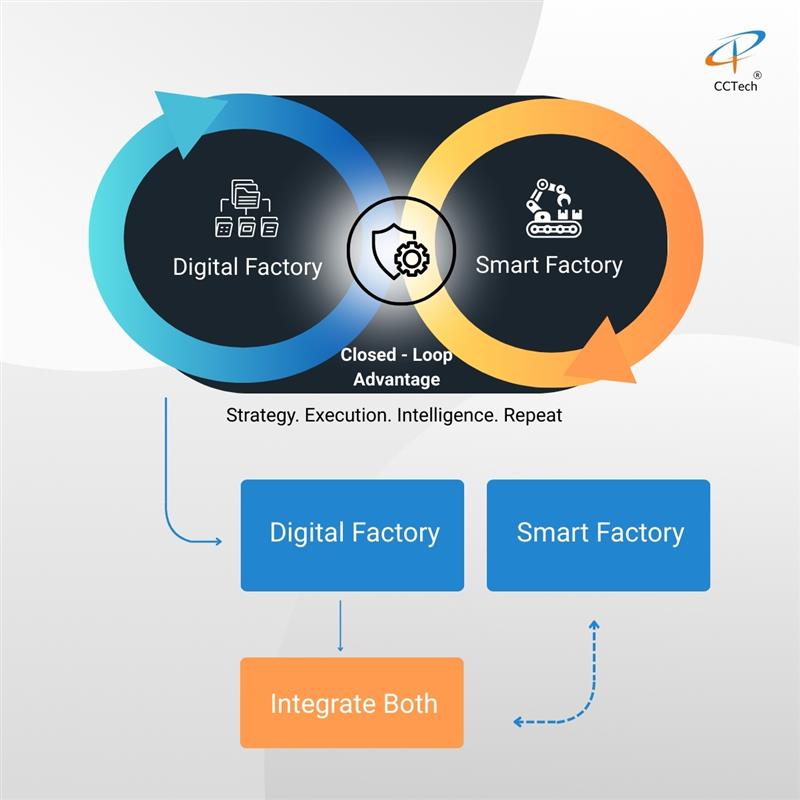
Connected together, the digital factory and smart factory form a closed-loop business model:
- Digital Factory identifies and validates best practices
- Smart Factory Act and optimal operates in real-time
- Operational insights are fed back to digital models
- Decisions in the future will be intelligent and fruitful.
This loop enables:
- Continuous improvement
- Better forecasting accuracy
- Stronger governance
- Sustainable competitive advantage
How Executives Should Prioritize
The optimal place to begin is dependent on business priorities:
The optimal place to begin is dependent on business priorities:
- Heavy capital investments or greenfield activities → Build up from a Digital Factory level
- Margin pressure or operational inefficiency → Begin with a Smart Factory
- Reliability, scalability, and resilience objectives → Embody both
The goal is not technological adoption, but a measurable business impact.
Final Takeaway
It isn’t as much about what gets created, but rather when and how the value is being created.
Better decisions:
Better decisions:
- The Digital Factory drives better business outcomes by helping leaders make better decisions
- A Smart Factory simply gets better results for organizations
Businesses that do both are in fact out of experimentation and into predictable ROI, with less risk and continuous profitability – turning digital transformation into real business advantage.
Comments
Recent posts
Message