





Friday, March 27, 2026
Topology Optimization for Modern Manufacturing
By
Aditya Shinde
Topology Optimization for Modern Manufacturing
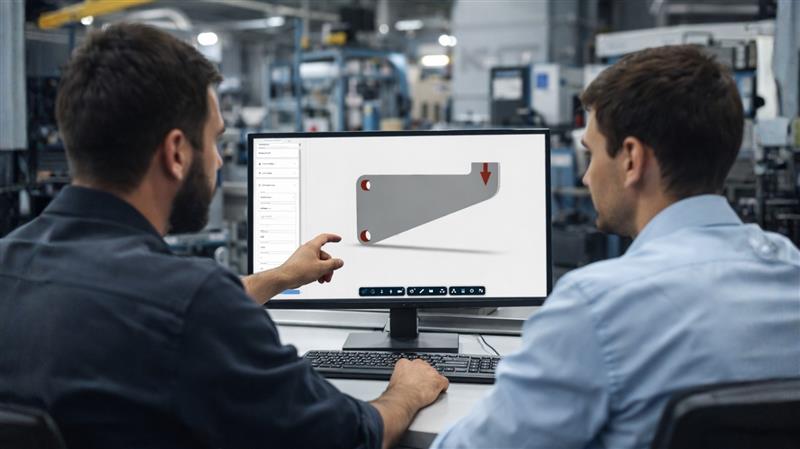
Modern manufacturing is continually evolving in terms of design and technology. Earlier, customers explained designs to engineering leaders in various forms, including 2D drawings, sketches, 3D scans, basic 3D models, and SLA files, among others. However, it was challenging to convert these designs into a manufacturable concept due to the complexity of the designs and the limitations of the existing manufacturing processes. Today, engineering leaders are also asked to work on 3D shapes that utilize fewer resources to achieve sustainability and simultaneously enhance performance, durability, and innovation. Traditional cycles don’t adhere to reduced material usage, time, and cost, which are essential for meeting the demands of modern manufacturing focused on sustainability and efficiency.
To stay competitive, modern manufacturing demands decisions based on real and accurate data. The best way to accomplish it is to implement it from the earliest design stages. Hence, project leaders choose topology optimization as a strategic move. It bridges computer-aided design (CAD) and computer-aided engineering (CAE) by using CAD geometry. Instead of manually identifying the load surface and optimization inputs of the 3D shape, topology optimization computationally determines the most efficient surface layout and its parameters to create optimized lightweight structures.
CCTech’s topology optimization platform enables engineers to define engineering constraints and objectives and generate optimized design concepts that retain load-bearing material. This helps teams achieve lighter components, lower material usage, reduced manufacturing costs, and improved performance through a guided workflow. Reduced manual rework and trial-and-error modeling bring advanced capability into a practical engineering workflow.
Discover our topology optimization services here: https://www.cctech.co.in/services/topology-optimization-platform
Discover our topology optimization services here: https://www.cctech.co.in/services/topology-optimization-platform
5.1 The Tech Behind the Optimized 3D Shape
The Bidirectional Evolutionary Structural Optimization (BESO) method, the core algorithm of topology optimization, employs finite element analysis (FEA) to define the relative density of elements as design variables. FEA is a numerical method used to predict how structures behave under different loads. The loads are divided into small and manageable portions. With the help of the BESO methodology, an iterative cycle is analyzed by the FEA to evaluate stress, stiffness, displacement, and load paths.
Our platform is based on the combination of the BESO algorithm and a strict FEA-based process. It produces structurally efficient designs, lightweight designs, and designs that are within realistic manufacturing constraints.
5.2 Topology Optimization Workflow via APS Web Viewer
The project requirement includes the need for a platform to interact with native CAD geometry in real-time. The Autodesk Platform Services (APS) web viewer is used to meet this requirement.It is a cloud-based, WebGL-based JavaScript library that enables developers to display 2D and 3D CAD models and data directly within a web browser.
The APS-based topology optimization platform developed by CCTech supports teamwork and improves visual representation. Teams define regions which are preserved, including mounting holes, connection interfaces, load surfaces, fixed surfaces and optimization parameters including material, optimization base, density, numerical ratios, stress and visualization layouts.
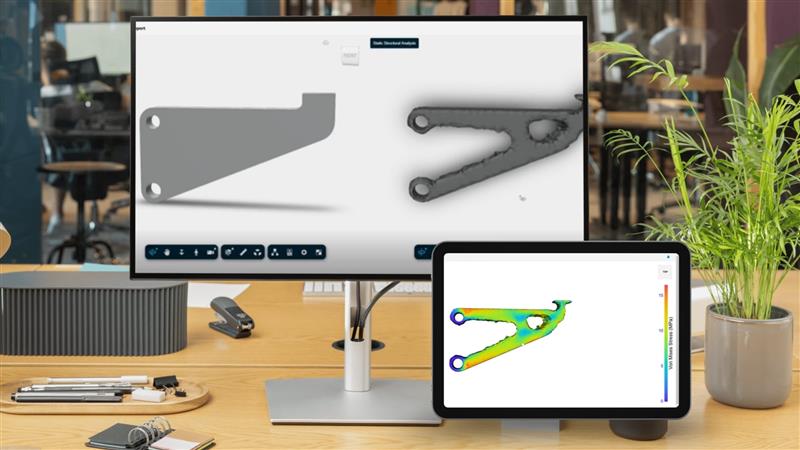
After defining the specific regions, boundary conditions, and design constraints, multiple FEA-driven iterations are executed in the background. This process evolves material distribution. Original and optimized geometries are compared side by side in the same APS viewer, and a detailed engineering report is exported for downstream CAD remodeling or manufacturing validation.
5.3 Tangible Benefits & Applications
The real question that prompts engineers to rethink after optimization is -
“What measurable impact will this have across applications?”
This is where the results of APS web viewer optimization transition from theory to business value for multiple applications.
-
Metal 3D Printing
Here, topology optimization ensures organic load-path-based shapes that are impossible with traditional machining. Materials are strategically added and removed based on structural necessity, which allows for the creation of complex geometries that optimise strength-to-weight ratios in the final product. The result is enhanced material efficiency with reduced build volume and raw material cost. -
Lightweighting of Machined & Cast Parts
With the help of optimization, 3D CAD layouts remove excess mass from the functional interfaces. This results in improved performance per unit weight and reduces machine time and costs. -
Early-Stage Design Exploration
During early-stage 3D CAD layout development, multiple structural variants can be evaluated before committing to detailed modeling. Since the process is based on simulation and decisions are based on physics, the iteration cycle length gets compressed. It strengthens cross-functional alignment between design and manufacturing teams.
Whether applied to metal additive parts, machined components, or cast structures, topology optimization ensures that 3D CAD layouts are no longer static geometry files—they become performance-optimized assets. Earlier, the parts were redesigned after cost overruns, which often led to delays and increased project costs. However, now it is optimized before it is released.
About author
Aditya Shinde
Aditya Shinde is passionate about engineering, innovation, software, and digital transformation. With hands-on experience in data analytics across AEC, manufacturing, and industrial domains, along with exposure to Industry 4.0, he writes to simplify complex technologies and share practical insights on how data-driven solutions and digital tools are transforming modern industries and manufacturing ecosystems.
Comments
Recent posts