


Wednesday, April 01, 2026
Integrate Autodesk Forma with Enterprise Applications for Connected Construction Ecosystem
By
Shubham Dom

Integrate Autodesk Forma with Enterprise Applications in Construction
The construction industry is moving in the right direction with digital transformation to build an interconnected system that allows data to flow freely across all levels of a construction project. However, a significant number of engineering, procurement, and construction companies have disconnected systems, with project teams and business operations not integrated.
This challenge has urged the organizations to take an imperative step towards integrating Autodesk Forma (formerly Autodesk Construction Cloud) with enterprise applications. This will create an environment in which design, execution, and enterprise intelligence are unified on a highly centralized platform.
Extending Autodesk Forma Integration Across the Ecosystem
To understand the value of integration, it is worth noting the different functions these systems serve within the project lifecycle.
Autodesk Forma is a cloud-based AECO industry platform that acts as a Common Data Environment (CDE) for conceptual design, planning, and early-stage development. It is intended to deliver projects, integrate the design, coordination, and execution process, and manage drawings, RFIs, issues, and field progress. It allows the team to work in a real environment with a single source of truth for all project-related information.
On the other hand, business-centric enterprise applications include ERP systems such as SAP ERP and Oracle ERP Cloud, as well as CRM systems.
Independently, both construction ecosystems are powerful. However, when they are used separately, a significant disconnect occurs - project implementation data is not fully aligned with financial, operational, and customer insights.
The real value emerges when this integration extends beyond core systems to other critical enterprise tools.
Autodesk Forma is a cloud-based AECO industry platform that acts as a Common Data Environment (CDE) for conceptual design, planning, and early-stage development. It is intended to deliver projects, integrate the design, coordination, and execution process, and manage drawings, RFIs, issues, and field progress. It allows the team to work in a real environment with a single source of truth for all project-related information.
On the other hand, business-centric enterprise applications include ERP systems such as SAP ERP and Oracle ERP Cloud, as well as CRM systems.
Independently, both construction ecosystems are powerful. However, when they are used separately, a significant disconnect occurs - project implementation data is not fully aligned with financial, operational, and customer insights.
The real value emerges when this integration extends beyond core systems to other critical enterprise tools.
For instance:
In such a constructional ecosystem, it is important to note that the integration of Autodesk Forma with an enterprise solution is the basis for all solutions to operate in synchronization. This creates a seamless flow of information throughout the project lifecycle.
- Scheduling tools such as Primavera P6 and Microsoft Project provide information to Forma, which then synchronizes it with cost and resource planning through an enterprise solution.
- CRM platforms such as Salesforce connect client information and contracts into enterprise and project execution solutions.
- Document systems like Oracle Aconex ensure information consistency across platforms.
In such a constructional ecosystem, it is important to note that the integration of Autodesk Forma with an enterprise solution is the basis for all solutions to operate in synchronization. This creates a seamless flow of information throughout the project lifecycle.
The Core Challenge and its Solution
Construction projects generate large volumes of information, including design documents, RFIs, price estimates, timelines, and procurement documents. Enterprise applications manage financials, contracts, and resource planning, whereas Autodesk Forma serves as a centralized system for project collaboration and document management.
The core challenge lies in seamless communication between these systems.
The core challenge lies in seamless communication between these systems.
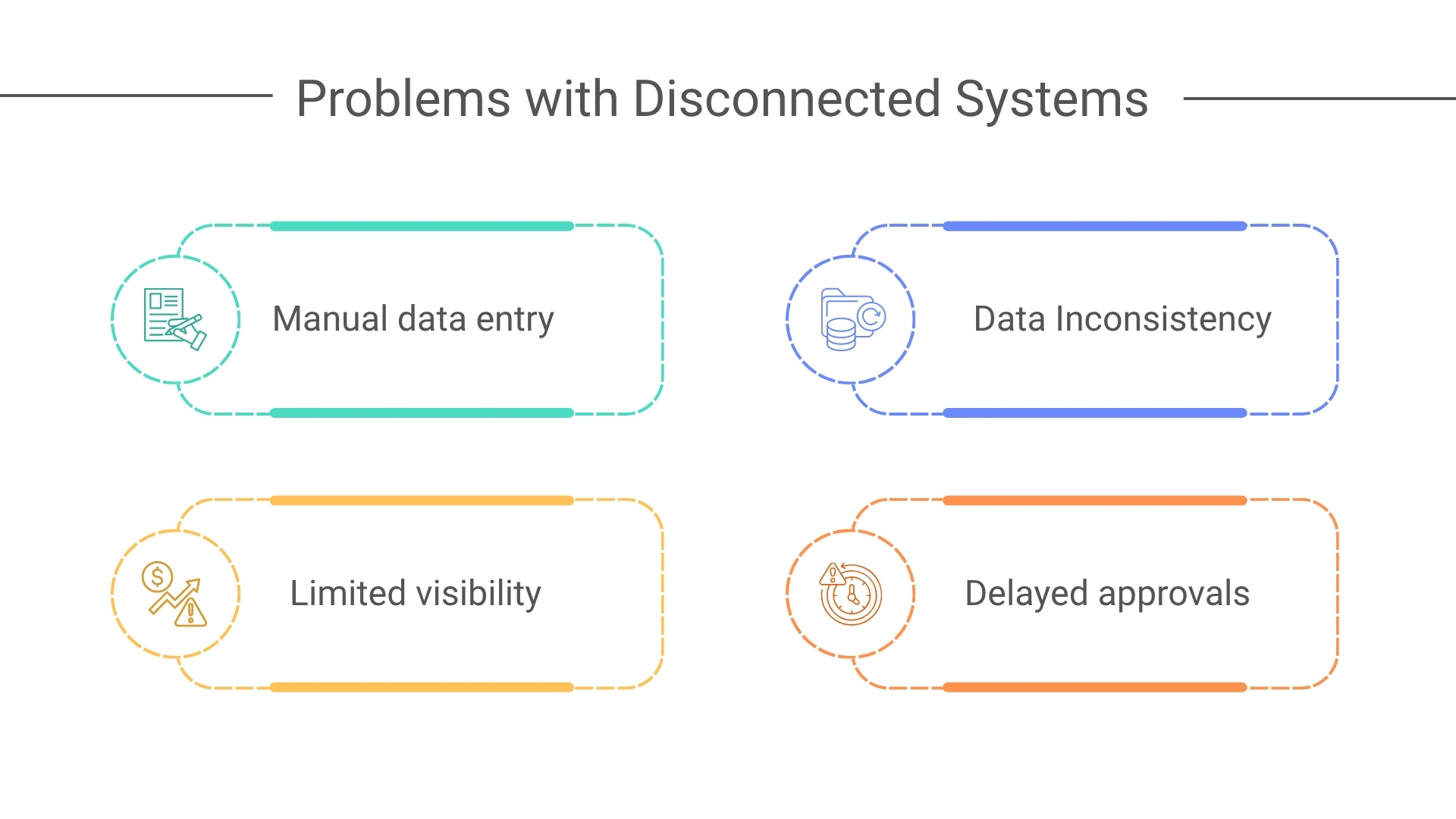
Based on the recent statistical report by Autodesk, KPMG study demonstrated that only 31% of projects came within 10% of the budget in the past three years. The key contributor to such cost overruns is inefficient data integration. In large-scale projects, it leads to 15–20% cost inefficiencies. (Source: Autodesk-Construction Industry Statistics, 2025 ).
The key advantages of integrating Forma with enterprise applications are:
The key advantages of integrating Forma with enterprise applications are:
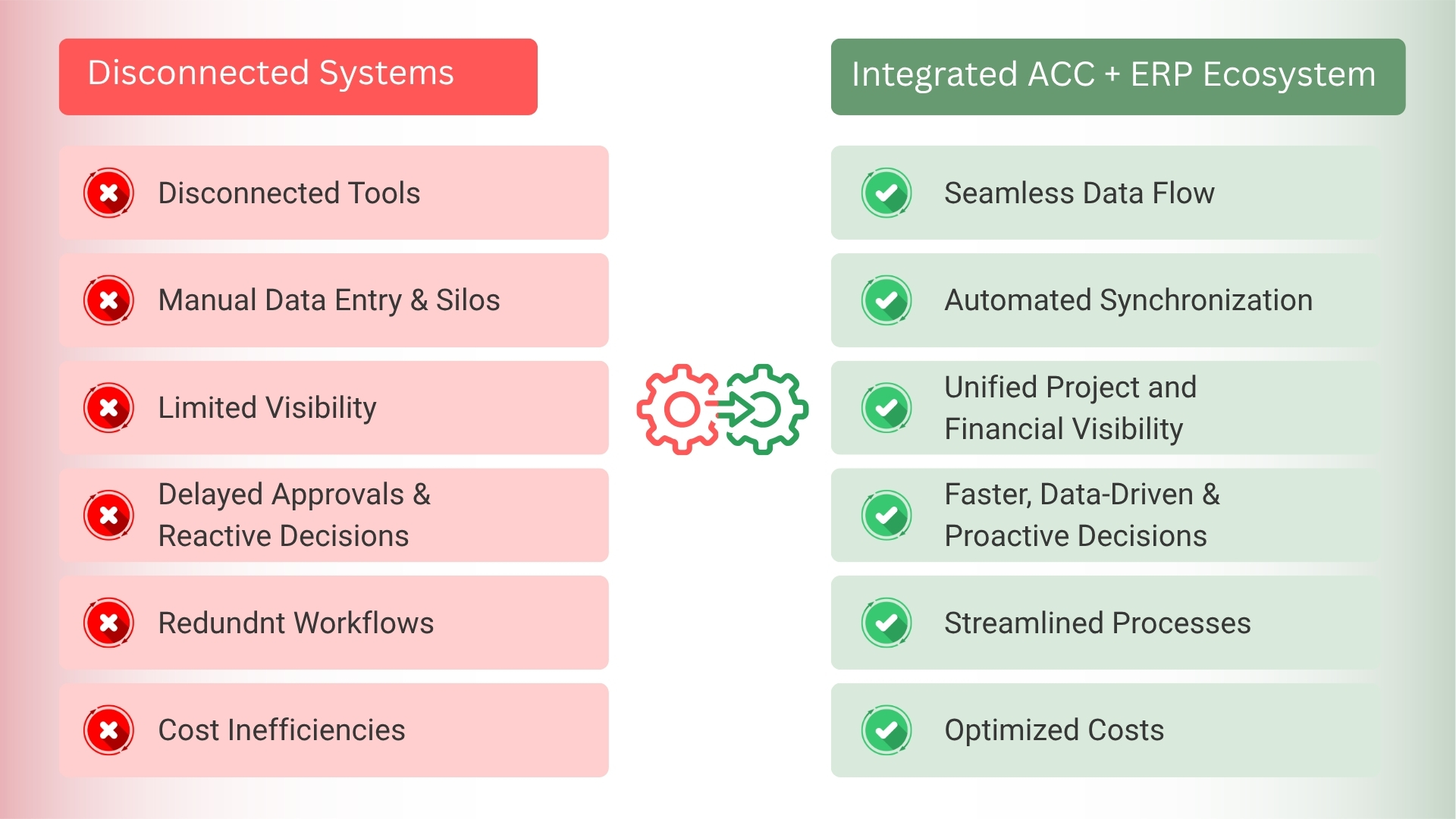
- Real-Time Project Alignment The integration ensures that project teams have real-time visibility of budgets, costs, and contracts. In this case, all updates, tracking, or field resolution are directly recorded in the enterprise application using Forma.
- Elimination of Redundant Workflows The largest hindrance to productivity within a company is the duplication of manual work. Integration provides synchronized data, eliminating data errors and enabling teams to focus on delivering high-value work.
- Improved Decision-Making Stakeholders can make responsible decisions faster with synchronized data. Executives could see how their projects are performing, gain access to operational insights, financial metrics, and effectively manage risk before it becomes a problem.
- End-to-End Project Visibility With integration, the organization can obtain a complete view of its project from its inception through design, planning, execution, and cost containment. Organizations having various departments and massive infrastructure projects are the most affected by this issue.
CCTech’s Role in Enabling Forma Integration with Enterprise Applications
The integrated construction setting creates an equally demanding environment and requires specialized modifications for organizations that develop and install integrated systems. CCTech helps organizations achieve this by providing a full range of services that enhance the connectivity of all data, automate workflows, and deliver instantaneous insights into project activities and organizational operations. CCTech's primary goal is to create connections with each integrated system that go beyond mere connectivity, adding value to each organization through enhanced decision-making, operational efficiency, and cross-departmental collaboration.
Explore how CCTech enables Autodesk Forma integration with enterprise applications:
https://www.cctech.co.in/services/autodesk-construction-cloud-integration
Explore how CCTech enables Autodesk Forma integration with enterprise applications:
https://www.cctech.co.in/services/autodesk-construction-cloud-integration
Conclusion
The construction industry is moving toward a model where success depends on how well systems and teams are connected.
Integrating Autodesk Forma with enterprise applications is not just a technical upgrade. It is a strategic change aimed at connected project lifecycle. It converts disconnected data into a continuous information flow, enabling the execution of enterprise goals.
Integration is vital in this field, as time, communication, and inefficiency are major factors. It enables the organization to be more proactive in executing the plan rather than managing it, thereby completing the project in a timely, controlled manner.
Integrating Autodesk Forma with enterprise applications is not just a technical upgrade. It is a strategic change aimed at connected project lifecycle. It converts disconnected data into a continuous information flow, enabling the execution of enterprise goals.
Integration is vital in this field, as time, communication, and inefficiency are major factors. It enables the organization to be more proactive in executing the plan rather than managing it, thereby completing the project in a timely, controlled manner.
About author
Shubham Dom
Shubham Dom is the Manager of the AECO business, driving Autodesk AECO and Autodesk Construction Cloud (ACC) solutions across India, Asia, and the Middle East. He focuses on building end-to-end digital construction management ecosystems, with ACC as the core platform integrated with custom applications and enterprise systems. He specializes in custom software development, Autodesk customization, and scalable platform design, delivering BIM-led and data-driven solutions.
Comments
Recent posts