



Tuesday, March 24, 2026
Digital Twin & BIM for Asset Performance Growth
By
Aditya Shinde
Digital Twin & BIM for Asset Performance Growth
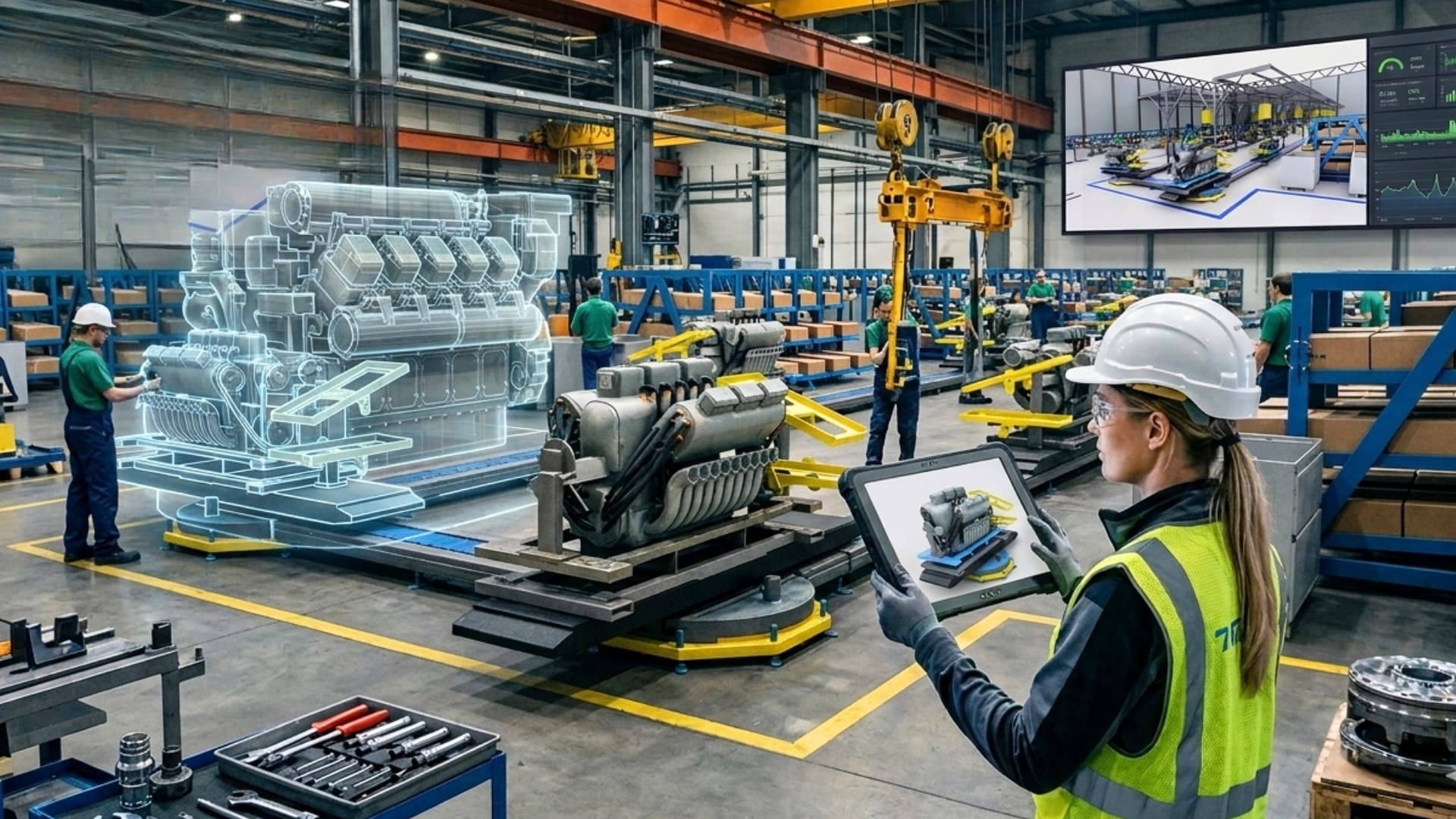
In today’s data-centric infrastructure ecosystem, businesses need smarter ways to optimize their businesses, reduce downtime, and improve efficiency. BIM models, used as a design tool, often lose their value once construction is complete. They become static references and is rarely updated or used. In this situation, the digital twin, along with BIM technology, is creating a giant impact. While bridging the gap between design and reality, this technology transforms how businesses use digital twin solutions.
What Digital Twins Mean in the Context of BIM
While understanding the impact, it is also important to know what digital twins are. Digital twins are defined as a digital representation of a physical asset, system, or infrastructure that uses real-time data to update its status. When a digital twin is integrated with building information modelling (BIM), it becomes a living model.
Traditionally, building information modeling (BIM) has been limited to the design and construction phases of a project. When digital twins are integrated with BIM, it becomes an operations intelligence tool.
From Static BIM to Intelligent Digital Twin Technology
The leap from BIM modeling to a digital twin at full scale requires integration with IoT sensors, real-time analytics, and cloud technology. BIM modeling allows an organization to gain geometric and structural intelligence, as digital twin technology enables real-time access to operational data, such as temperature, vibration, usage patterns and performance metrics.
This helps organizations with in-depth knowledge about their assets with this integration. They can monitor their assets in real-time rather than relying solely on historical data and physical observations. This allows better decision-making capabilities while ensuring that their infrastructure systems are running at optimal levels.
Using Digital Twins to Enhance Asset Performance
One of the major advantages of digital twin technology is its capability to improve asset performance. With the help of digital twins, organizations can identify areas of inefficiency and potential failure, improving their performance.
For instance, an organization with an industrial facility or a smart building can create a digital twin with the help of BIM to improve performance monitoring. In the event of a failure, the system will send alerts, thus improving performance.
The constant feedback loop between the physical and digital environments ensures higher efficiency, longer asset lifespan, performance monitoring, optimization and improved ROI. This, therefore, means that the organization will realize cost savings, as well as an increased lifespan of its assets, thus improving its return on investment.
Enabling Predictive Maintenance with the Help of BIM and Digital Twin
Furthermore, this integration drives predictive maintenance. Usually, maintenance practices involve regular check-ups and reactive maintenance strategies. Such an approach often leads to unplanned downtime.
However, digital twin technology allows for data-driven maintenance. This is possible because sensors installed in the assets send real-time and historical data to the BIM model.
For example, vibration data from the machinery indicates early signs of failure. Early prediction of breakdown helps in reducing the downtime by up to 25%, thereby lowering maintenance costs.
Digital twin technology facilitates predictive maintenance, reducing unplanned downtime and maintenance costs.
For example, vibration data from the machinery indicates early signs of failure. Early prediction of breakdown helps in reducing the downtime by up to 25%, thereby lowering maintenance costs.
Digital twin technology facilitates predictive maintenance, reducing unplanned downtime and maintenance costs.
Why Businesses Need Digital Twin Built on BIM
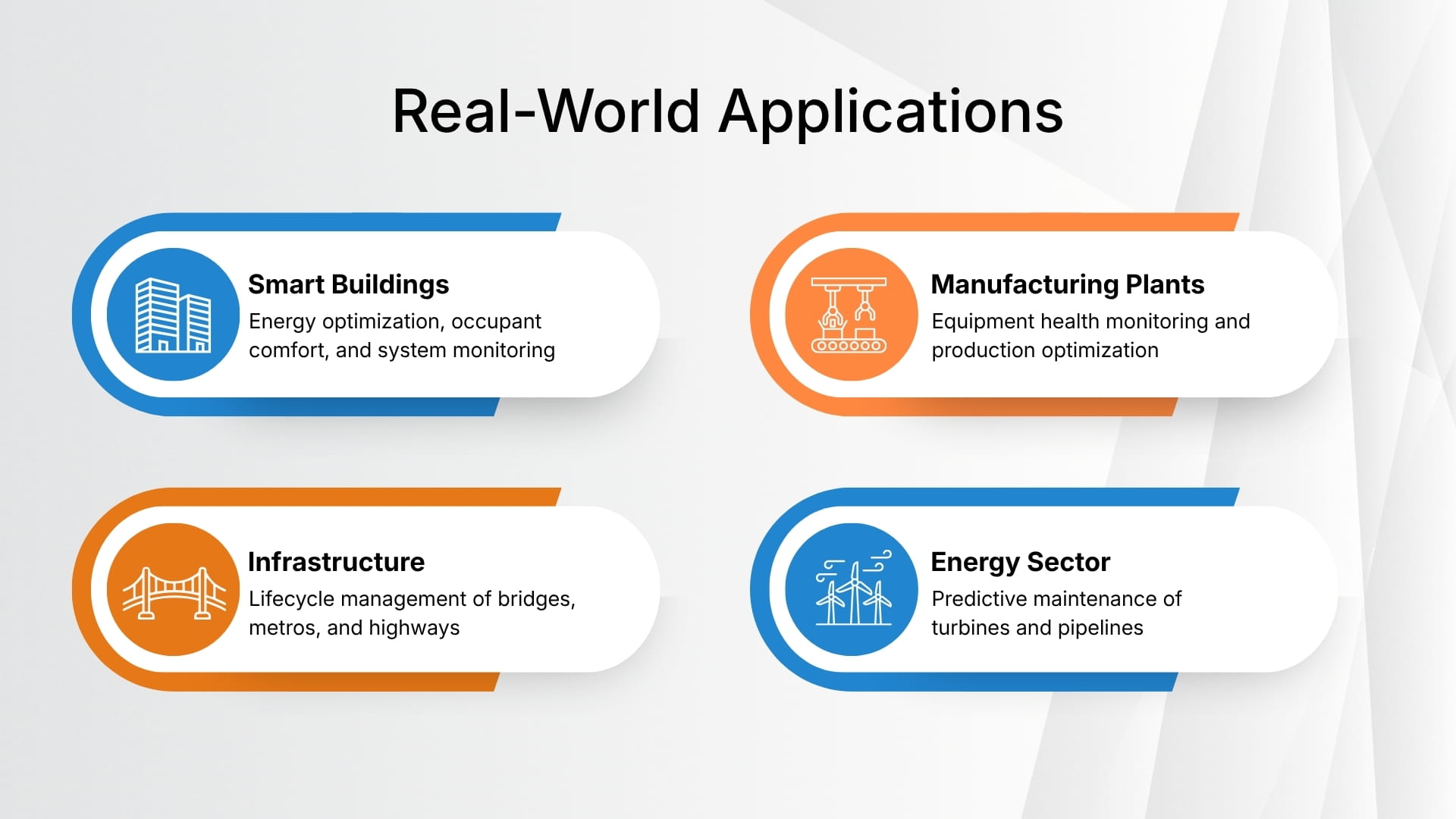
The organizations are preferring this technology as it helps them leverage the full potential of their existing BIM modeling assets. Rather than allowing their BIM modeling assets to go underleveraged in the construction space, they can now be used in the operational space as well.
This capability is crucial in industries where assets play a critical role in their business. By using the power of BIM and real-time information, organizations can gain a competitive advantage in their respective industries. Its adoption will impact the business value by reducing the energy, unplanned downtime and operational costs, thereby extending asset lifecycle management.
The ability of this technology to provide a means of predictive maintenance also ensures the sustainability of their assets.
This capability is crucial in industries where assets play a critical role in their business. By using the power of BIM and real-time information, organizations can gain a competitive advantage in their respective industries. Its adoption will impact the business value by reducing the energy, unplanned downtime and operational costs, thereby extending asset lifecycle management.
The ability of this technology to provide a means of predictive maintenance also ensures the sustainability of their assets.
The Future of BIM and Digital Twin Technology
With further technology upgrade, it is expected that integration of BIM, AI, machine learning and cloud technologies will make digital twins more intelligent, autonomous, and streamlined. Advanced analytics and AI will further improve predictive maintenance capabilities.
The meaning of digital twin in the future: The concept of digital twin in the future is not expected to be confined to individual objects but to entire ecosystems.
Conclusion
The integration of digital twin technology and BIM changes the way organizations manage their asset and infrastructure. The capacity to improve asset performance and develop effective predictive maintenance is tremendous by converting static BIM to dynamic real-time models.
As industries target higher efficiency and sustainability, the adoption of digital twin technology is no longer a choice but a necessity to stay competitive in a rapidly changing world.
As industries target higher efficiency and sustainability, the adoption of digital twin technology is no longer a choice but a necessity to stay competitive in a rapidly changing world.
About author
Aditya Shinde
Aditya Shinde is passionate about engineering, innovation, software, and digital transformation. With hands-on experience in data analytics across AEC, manufacturing, and industrial domains, along with exposure to Industry 4.0, he writes to simplify complex technologies and share practical insights on how data-driven solutions and digital tools are transforming modern industries and manufacturing ecosystems.
Comments
Recent posts